

After years of anticipation, the Grand Egyptian Museum (GEM) is gradually opening its doors, with its various sections becoming accessible to the public. It stands as one of the world’s largest and most advanced archaeological museums.
- Prime Location
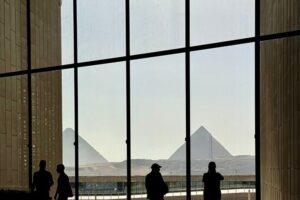
Located near the Giza Pyramids, the museum spans nearly half a million square meters. Visitors can experience both the museum and the three famous pyramids in a single visit.
- Tutankhamun’s Timeless Treasure
For the first time, the full collection of nearly five thousand artifacts from Tutankhamun’s tomb has been assembled in one place. Previously, only a portion of these treasures was on display at the Cairo Museum.

- The Majestic Staircase
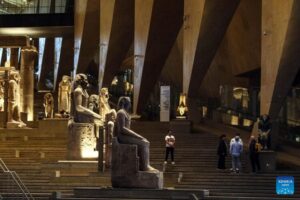
A grand and impressive staircase marks the entrance of the Grand Egyptian Museum, with eighty-seven statues of ancient Egyptian kings and deities lining both sides in chronological order. It represents the journey from Egypt’s past to the present.
- Mummies and Valuable Artifacts
Items from different ancient Egyptian dynasties—including royal mummies and burial equipment—are preserved and exhibited using advanced modern technologies. - Remarkable Architecture
The museum’s design combines contemporary aesthetics with traditional Egyptian elements. Its main facade faces the pyramids, featuring high-quality materials and cutting-edge construction technologies.

- Tutankhamun Hall: A Complete Collection
Dedicated to Tutankhamun, this hall showcases all of his masks, jewelry, chariots, and golden coffins, presenting the entirety of his priceless treasures. - Cutting-Edge Display Tools
The museum integrates smart lighting, interactive screens, augmented reality, and multilingual audio guides to offer visitors an immersive journey through history. - The World’s Largest Civilization-Focused Museum
The Grand Egyptian Museum is the only museum entirely dedicated to a single civilization—ancient Egypt—and houses more than 100,000 historical artifacts. - Advanced Restoration and Conservation Studios
Within the museum, specialized laboratories and restoration workshops allow artifacts to be preserved, studied, and restored on-site. - Educational and Cultural Facilities
The museum includes learning centers, conference halls, a dedicated library, and children’s spaces to support its cultural and educational mission. - Vast Main Exhibition Hall
The permanent exhibition hall covers nearly 24,000 square meters, ranking among the largest exhibition spaces in the world.

- World-Class Preservation and Safety
The museum’s preservation and safety systems—including controls for temperature, humidity, and lighting—are built to international standards to ensure the protection of all artifacts. - “Winged Sun” Glass Display at the Entrance
At the main entrance, a monumental glass display featuring the symbolic “Winged Sun” (Horus) immediately captures visitors’ attention. - Tutankhamun’s Tomb Recreated
Among the museum’s most striking exhibits is the meticulous reconstruction of Tutankhamun’s tomb, exactly as Howard Carter discovered it in 1922. Visiting this exhibit offers the feeling of uncovering an ancient secret. - Advanced Restoration and Conservation Center
The museum features one of the world’s most sophisticated laboratories for artifact care, where visitors can observe restorers working on mummies and statues through specialized glass panels. - Large Multimedia Hall and Virtual Reality Center
The museum includes a hall for 3D film presentations and a virtual reality center, allowing visitors to explore ancient Nile settings and the interiors of historical tombs. - Garden of Ancient Monuments
Surrounding the museum is a vast, beautifully arranged garden featuring statues, stone columns, and architectural symbols from ancient times, offering visitors a peaceful space for reflection. - Cafés Overlooking the Pyramids
Several cafés and tea houses within the museum provide direct views of the pyramids. Sipping tea in the shadow of these monumental structures is part of the unique experience of visiting. - Pharaoh Khufu’s Solar Boat
The ceremonial boat of Pharaoh Khufu, discovered beside the Great Pyramid, has been fully restored and is displayed in a specialized gallery under carefully controlled preservation conditions. - Exclusive Museum Shops
Visitors can find high-quality replicas of ancient jewelry and handcrafted works by modern Egyptian artists in the museum’s shops. - Themed Exploration Routes
The museum offers multiple suggested paths for visitors, including “The Pharaoh’s Journey,” exploring life and death, and “Gods and Rituals,” for those fascinated by mythology and religion. - Exhibits That Tell a Story
Artifacts are presented in context, with each gallery narrating a continuous story of ancient Egyptian civilization.
In Summary:
The Grand Egyptian Museum is not merely a repository of ancient artifacts; it is a cultural hub where modern expertise, architectural brilliance, storytelling, and hospitality converge to make history come alive. It stands as both a national treasure of Egypt and a cultural milestone for the world, offering every visitor a truly unforgettable experience.
For Iranians, observing Egypt’s achievements in museum curation is a poignant reminder. Once a leader in preserving artistic, historical, and civilizational heritage, Iran now watches its extraordinary legacy remain in the shadows—overshadowed by inefficiency and missed opportunities.