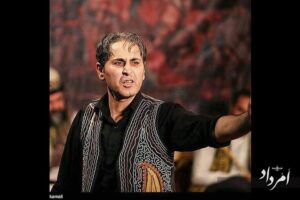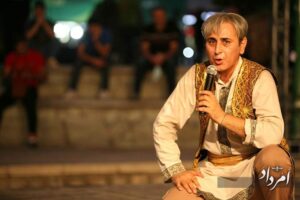


Murshid Mohammadreza Majooni is among the most seasoned and knowledgeable storytellers I know. With a master’s degree in theatre and a deep understanding of the Shahnameh, he embodies the learning factor, essential to naqqali.
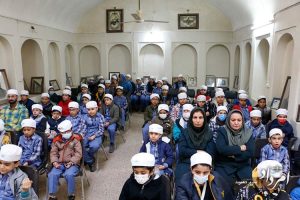
I reached out to him for an interview for Amordad Weekly, and he accepted with genuine warmth, saying the publication is one of his favorites. We met at Fadak Cultural Center after his performance of the “seven adventures of Rostam,” a show tailored for children.
I asked him the question I pose to every storyteller:
How and when did you begin?
He recalled, “My grandfather knew the Shahnameh by heart. One day, while I was playing in the courtyard, I heard him reciting:
‘I am Manizheh, daughter of Afrasiab,
The sun has never seen my body unveiled.’
That was the first verse I ever heard from the Shahnameh. Its cadence stayed with me, and at five years old I fell in love with its world. Having a father named Rostam also made me imagine the stories were about him,” he added with a laugh.
He continued, “My father had watched storytellers in Tehran’s old coffeehouses. When he noticed my interest, he shared whatever he remembered. Later, I moved from Garmsar to Tehran to work in theatre. One day at the City Theater, I saw someone performing naqqali. I was so mesmerized that I forgot the job I had to do and simply sat down to listen. I learned he was Murshid Valiollah Torabi. From then on, I followed his performances wherever I could — and soon after, I began performing myself.”
Where was your first official performance?
“I first performed parde-khani at the Fajr Theatre Festival in the open-air space of Tehran’s City Theater. Masters like Murshid Ahadi, Murshid Chayani, and Murshid Mirza Ali were present. After watching me, they said I had the essence of the craft. That encouragement pushed me to study the Shahnameh seriously and dedicate myself to training. It has been about twenty years since then.”
Did you also perform at international festivals?
“I’ve performed in nearly twenty countries, and both Iranian and international audiences responded warmly. In some shows, I add zarb, singing, or daf. I play the zarb myself while narrating. Naqqali has enough power on its own to engage the audience, but music can add a touch of color, even though it isn’t necessary.”
Which story of the Shahnameh do you feel most attached to?
“I’m connected to all of them, but the tale of Rostam and Sohrab has been my companion the longest. I’ve read it more than a thousand times, and whenever I have a quiet moment, I return to it.”
How do you view today’s naqqali performances?
“To be honest, aside from a few who perform the tradition properly, many are harming it through distortion and lack of knowledge. Naqqali is an ancient tradition; it has its own etiquette. I don’t see why it should be altered so casually. I follow the classical method, specifically the Tehran school, because audiences still connect with authentic performance. Naqqali isn’t just storytelling. It’s heroic speech, rhythmic phrasing, digressions, moral anecdotes, and a storyteller with enough depth to hold an audience for an hour.”
“I’ve performed in T-shirts and jeans, and I’ve tried digital parde-khani, but none of it matches the strength of a traditional performance. The attire, the presence, the classic introductions — these are what captivate people and keep the legacy of naqqali alive.”
What role does the toomaar (scroll) play in naqqali?
“Since ancient times, it’s been said that without a toomaar, one cannot claim the title of naqqal. Every storyteller must create their own written narrative and perform from it. You may draw on the works of earlier masters, but only with clear acknowledgment, and even then, you must make the words truly your own. They have to settle into your spirit. Imitation is acceptable only at the very beginning. But anyone who hopes to be recognized as a naqqal must eventually find their own style and craft their own toomaar. I’ve written nearly ten of them myself, though I won’t publish them until I feel they are fully refined.”
How do you envision the future of naqqali?
“My wish is to see so many storytellers that, wherever you walk, someone is performing in a corner. At the same time, I worry. The future of this art depends on preserving its principles. In my classes — with students ranging from seven to seventy, and with my own child who loves this tradition — I insist on two things: respect the elders who shaped this art and carry the legacy as though you alone are responsible for keeping it alive. Naqqali must endure, because Iran must endure. Everything I do stems from that love.”