

In 1395 (2016/2017), while searching through archival films at the Theater Department, I first saw and heard the performances of narrators from various periods of the Traditional Festival, particularly in the section dedicated to coffeehouse plays. Since then, I have attended their performances on multiple occasions, most recently at the 22nd traditional/ceremonial festival held this year.
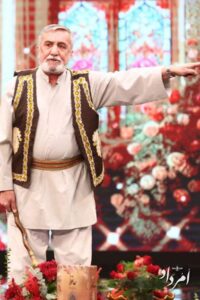
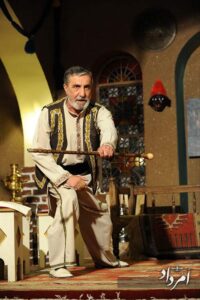
Morshed Mehdi Chayani, a veteran narrator and holder of the highest artistic rank—equivalent to an honorary doctorate—belongs to a generation of storytellers who have deeply honed their craft and experienced the ups and downs of life. Born in 1333 (1954/1955) in Hamedan, he has dedicated over half a century to the art of narration and to serving the Shahnameh.
When asked about his own mentor and how he entered the field of narration, he recalled:
“I learned narration from two masters during my childhood and adolescence: Morshed Afshar and Morshed Azim, famously known as Morshed Chelagh. My father was an avid reader, and our home was filled with literary works and poetry. Sometimes, I accompanied him to coffeehouses, where I witnessed storytelling performances. I was so captivated that I began practicing famous stories like Rostam and Sohrab, Sohrab and Gordafarid, and Zahhak on my own.
In those years—specifically 1350 (1971/1972)—I participated in a student festival held in Tus, where I won first place in narration. I still have the certificate as a keepsake. That recognition sparked my determination to continue seriously, study under these two masters, and fully devote myself to the art of storytelling.”
“Storytelling and Narration Are Not Learned in a Day”
Morshed Chayani explained the essential qualities of a skilled narrator:
“Storytelling is not something you can master by memorizing a few poems or tales and repeating them mechanically. Traditionally, one would sit with a master narrator, observe closely, and then practice performing for a small audience—sometimes with the master’s permission, sometimes discreetly—until the craft was fully understood.
A narrator must possess four core qualities:
First, empathy and social awareness. A good narrator must understand and connect with the audience—what comes from the heart will naturally reach the hearts of listeners.
Second, expressive delivery. Mastery of rhythm, pauses, tone, and subtlety in speech is crucial, even in action-packed or battle scenes. Beginners often overuse gestures or the mentesha (a knotted wooden staff), which can undermine the story’s charm. Proper expression is the foundation of great narration.
Third, memory. A narrator must memorize poems, anecdotes, proverbs, moral tales, and stories from various sources. They need the flexibility to expand or condense the narrative as the moment requires. In the old days, mystics carried a chanteh—a bag of tools. For a narrator, the chanteh is memory. Beyond the Shahnameh, a skilled narrator knows diverse stories to skillfully incorporate or pivot into religious or other tales when appropriate, before returning seamlessly to the main narrative.
Fourth, visualization. The late Morshed Torabi said that a narrator must vividly imagine every scene they describe: the glint of a sword, the clash of a mace, or the tension of a chase. A narrator essentially builds a mental cinema of their stories, allowing the audience to experience the tale as if it were unfolding before them.”
Asked about the qualities of the older generation of narrators that are rarely seen today, Morshed Chayani reflected:
“In a single word: authenticity. They truly made the stories their own, and their style was entirely unique. I remember when I first began, out of ignorance, I tried to imitate Morshed Afshar, who had a deep voice. I changed my own voice, and as a fourteen- or fifteen-year-old, I sounded like a sixty-year-old man. I soon realized how mistaken I was. A narrator must speak with their own voice—imitation is only a stepping stone. You take what you need from it and then move forward.”
On whether the tradition of narration should continue, he said:
“Several years ago, the ‘Coffeehouse Plays Festival’ was held in Zanjan, attracting many narrators. Mr. Majid Rahmati, a theater actor, performed Romeo and Juliet as a narrated tale, and we all appreciated it because the essence of storytelling remained intact, even though the story was different. Today, however, there is little proper guidance for teaching this ancient art, leaving young narrators uncertain and sometimes misdirected. The work must retain its authenticity. Young narrators can, of course, introduce new techniques and touches to engage modern audiences, but that is where their own creativity must shine.”
On the Heartbreaks and Challenges of Being a Narrator
Morshed Chayani spoke openly:
“My conversations with you and other narrators have always been warm and friendly. Simply put—yes, I have felt heartbroken along this path.
There was a time when international performances were fully supported by cultural attachés. I traveled to over ten countries, narrating the Shahnameh. But today? Who truly values this art? It often feels as if artists are being dismissed. Once, during a performance for a government organization, an official asked, ‘What are you doing? You’re just telling a 20-minute story.’ I replied, ‘You’re listening for 20 minutes, but behind each minute lie 20 years of practice, effort, and dedication. Go ahead—bring someone from the street to do the same. Can they?’
So yes, I have been disheartened many times. Beyond my deep love and respect for the Shahnameh, seeing the art undervalued and ignored has been discouraging and painful.
As the saying goes:
“The tongue rests in the keeper’s mouth; if I speak, it burns; if I remain silent, it scorches my very bones…”
To anyone wishing to pursue this path, I say: enter with love. Narration is one of Iran’s oldest, most enduring, and authentic arts, with a history spanning thousands of years. My hope is that, despite modern distractions and challenges, this noble tradition remains strong, vibrant, and proud, passed down from one generation to the next.”