

More than a week after concerns were raised about the risks of constructing a commercial project within the protected zone of the Golestan Palace—and amid the continued silence of the Cultural Heritage Organization—heritage activists have issued a new alert. Citing documents showing that permission has been granted for four underground floors reaching a depth of 17 meters, they warned that studies by the Building and Housing Research Center and the Tehran Disaster Prevention and Management Organization in 2024 classify the project site as a highly vulnerable area for land subsidence.
As reported by ISNA, heritage activist Vahid Shahab stated that the UNESCO-listed Golestan Palace stands in Tehran’s historic and densely built center, on soft, fine-grained alluvial layers, and above a network of old qanats that create a complex pattern of subsurface water flow. In such conditions, any change in soil lateral pressure or groundwater movement may cause localized subsidence, cracking in adobe and brick walls, and erosion of the foundations of nearby historic structures.
He added that the World Heritage dossier for the Golestan Palace identifies development pressure, environmental factors, natural hazards, and the impact of proximity to the Tehran Bazaar and the Naser Khosrow axis—including increased construction density and long-term cumulative stresses—as ongoing threats to the palace’s structural stability.
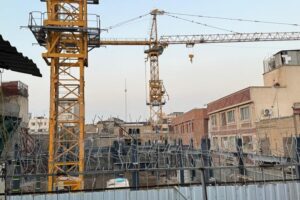
He added that the mentioned property lies within the buffer zone of the 700-year-old Mehrgard qanat, less than 25 meters away, and according to historical records, the Shams-ol-Emareh square previously served as the qanat’s outlet, providing water access to the public. Studies by the Road, Housing, and Urban Development Research Center and the Tehran Disaster Prevention and Management Organization in 2024 also identified this area as highly vulnerable to subsidence.
Shahab stated that all these factors, along with the project’s proximity of less than 50 meters to the Shams-ol-Emareh structure, necessitate preventive measures and detailed geotechnical modeling, mapping of historical qanat paths, assessment of groundwater flow, and evaluation of the impact of new building loads on the stability of historic structures before any excavation.
He further noted that, according to the permit recently issued by the Director-General of Tehran Province’s Cultural Heritage, Tourism, and Handicrafts Organization, constructing four underground floors to a depth of 17 meters in this project has been deemed “authorized,” which, including the foundation, would result in excavation to nearly 20 meters. The question now arises whether, considering the experience of the Atlas Mall Niavaran project and its impact on the Sahebqaraniyeh Palace, the owner should have been required to conduct geological, geotechnical, and hydrogeological studies before receiving approval.
Shahab also asked whether the experience of declining groundwater levels and its effects on Naqsh-e Jahan Square, the structural cracks in Imam Mosque and Ali Qapu Palace, subsidence on Hasht Behesht Street in Isfahan, and the impact of surrounding construction has been forgotten.
The cultural heritage activist called on the Minister of Cultural Heritage, Tourism, and Handicrafts and the Minister of Roads and Urban Development to issue an order to halt this project until technical, functional, heritage, and geotechnical studies are completed, stressing that continued construction could cause irreversible damage over time.