

For a long time, scholars have noted that none of the countless reliefs and murals from Persepolis, Susa, or Pasargadae depict women. Yet archaeologists have found a woman’s face painted in white on a broken piece of glazed brick from an Iranian structure in Babylon. Another brick fragment from Susa shows a white hand, adorned with bracelets, holding a spear—though this hand likely did not belong to a woman. Some have even claimed that ancient Iranians never depicted women at all. Still, accidental discoveries like these deserve attention. It appears that within the grand imperial programs meant to display authority and power, women had little visible role.
However, in smaller artworks, numerous depictions allow us to form a fuller understanding of women in the vast Persian Empire.
One of the first details that stands out is women’s clothing. They wore pleated Achaemenid dresses and caps similar to those worn by men. The crenellated head covering is particularly notable. Because men also adorned themselves with elaborate ornaments and jewels, distinguishing genders can be difficult. Even decorative motifs, such as holding a lotus, appear the same for both men and women. Moreover, it is clear that a uniform fashion prevailed throughout the empire. Noble women likely observed the royal court at Persepolis and sought to emulate its luxurious attire.
For example, a limestone relief recovered from Egypt, now in the Brooklyn Museum, depicts a woman wearing a pleated Achaemenid dress. The horizontal pleats on the front and the carefully arranged folds form arches identical to those seen in Persepolis reliefs. The garment is beautifully tailored, with the back extending to the ground. The sleeves are wide and flowing, and the hands are clasped in front. She wears a multi-strand pearl necklace, similar to one found at Pasargadae. Large rings adorn her ears, and her hair is held in place with a band decorated with lotus motifs.
This headband is identical to the one worn by the king’s guards in the Bisotun reliefs. The hairstyle itself is also reflected in the fashions seen in Persepolis reliefs: short hair arranged in dense, wavy circular layers around the head, mirroring the king’s own hair.
The same hairstyle appears on a head sculpture recovered from Persepolis. This head, following the lapis lazuli style, is coated with a blue glaze, while the eyes and eyebrows are made from glassy enamel in a contrasting color. This head may belong to a woman. Other possible female examples include a limestone head found in Masjed Soleyman or a terracotta head from Susa. Similar fashions were also observed in Syria. For example, countless small terracotta statues of goddesses in the act of giving birth, recovered from Ishtar temples, appear during the Achaemenid period wearing garments that show traces of pleated Achaemenid dress.
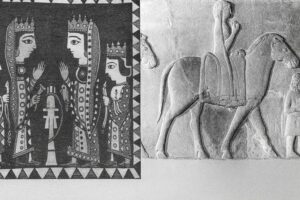
As was customary, these statues follow the ancient mobile Ishtar style, holding their chests with both hands. Some even depict goddesses fully dressed in Achaemenid court attire. The hems and borders separating different parts of the garment resemble Achaemenid clothing, and the goddess often holds a lotus flower in her hand. Additionally, she wears a crown reminiscent of the king’s cap in the Hall of Reception, decorated here with a zigzag pattern.
Among cosmetic items, bronze kohl containers shaped like women have been discovered, with the example from the Foroughi private collection being particularly exquisite. The female figure, serving as a kohl container, wears Achaemenid clothing, notable especially for the elegance of its sleeves. Long hair flows down her back, and she wears a wide pearl necklace around her neck.
The handle of a kohl container, designed like the base of a chair, was made slightly taller for practical use, with a bird perched on top. A similar bronze kohl container, though less finely crafted, is preserved at the Ashmolean Museum in Oxford. The hair falls over the shoulders, intricately braided, while the pleats on the back of the garment hang in successive horizontal arches.
Another kohl container, discovered in a woman’s grave on Kish, had a silver covering. This example also features the pleated Achaemenid dress and a figure with short, curly hair. The same style of clothing for noblewomen and their attendants is depicted on Gobelin textiles found in southern Russia at the Pazyryk burial site.
Women’s garments were made from more fabric compared to their attendants’ attire, a difference visible in the garment borders and sleeve designs. The crenellated cap mentioned earlier was sometimes covered with a veil. Women dressed in this style are also commonly depicted on seals, with a particularly beautiful example now in the Louvre Museum in Paris.
It seems that the banquet scene at Persepolis served as the model for this seal. Just as the king is shown seated at the banquet, the seal depicts a high-ranking woman sitting on a throne-like chair with a tall back, her feet resting on a footstool, holding a lotus flower in her hand.
The woman’s attire reflects the dress of the Achaemenid court. Her cap resembles a crown, draped with a veil. Unlike the traditional depiction of a goddess, this portrayal shows a high-ranking woman whose courtly demeanor emphasizes her status and authority.
In front of her stands a maid with long braided hair, holding a bird similar to the one seen atop the handle of the kohl container. This bird could be a decorative ornament, a toy, or even a live bird, such as a canary, for the amusement of a noblewoman. A larger-than-usual incense burner has also been discovered, consciously echoing the royal banquet at Persepolis—except that, in this case, a female attendant is depicted instead of a male servant. Like the attendants shown on Pazyryk textiles, she wears a pleated garment and a crenellated cap.
Numerous seals depict Iranian women in pleated attire. For instance, a seal in London shows a woman holding a lotus flower, with long hair braided at the ends. Another seal in Oxford depicts an Iranian man in riding attire seated on a footstool, while a woman in a different garment serves him a cup. A seal in Toronto shows a woman carrying a complete set of drinking implements—a ewer, cup, and ladle.
The Jeyhun collection also contains countless depictions of women. On the interior of a small silver box, a woman in pleated court attire is depicted alongside a man dressed in traditional Iranian riding clothes.
On several gilded leaves—likely intended for offerings and devotion, much like modern Orthodox and Catholic pilgrimage sites—women are depicted holding lotus flowers. Two additional ring seals each show a seated woman holding either a flower or a bird, indicating that this type of female imagery was widespread and consistently represented.
A seal now in London clearly demonstrates that the bird, commonly shown in seated depictions, was not meant for sacrifice to the gods. In this case, a seated woman is handing a small bird to her daughter as a plaything.
These examples show that countless depictions of women from the Achaemenid period exist in which clothing, headwear, and adornments are largely indistinguishable from those of men. Even ceremonial scenes, such as the famous royal banquet at the central Apadana staircase, were emulated by women across the Persian Empire.