

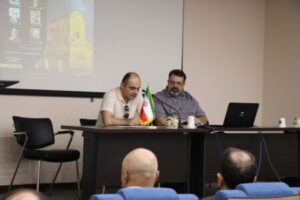
A seminar titled “Cyrus the Great in Light of Modern Research” was held at the Research Institute of Cultural Heritage and Tourism to mark Cyrus the Great’s commemoration. Speakers included Cyrus Mohammadhkhani, Kamyar Abdi, Yaser Malekzadeh, and Alireza Hassanzadeh, with Mehrdad Malekzadeh serving as secretary. Mohammad Ebrahim Zarei, the institute’s head, also addressed Cyrus’ legacy. Shahrokh Razmjou was scheduled to speak but was unable to attend.
Iranians as Pioneers of Peace and Tolerance
Zarei emphasized that Iranians have historically led in promoting peace and tolerance. He described Cyrus the Great as a ruler who established peace and whose Charter of Peace continues to inspire globally. Cyrus not only promoted tolerance but ensured it was passed to his successors. He remains a vital legacy for Iran, with governance rooted in friendship, moderation, and peace.
Zarei added that while discussions in Iran have sometimes been marked by extremes or self-criticism, archaeological evidence clearly confirms Cyrus’ historical significance and contributions.
Assyrian vs. Achaemenid Thought
The head of the Research Institute of Cultural Heritage highlighted the contrast between Assyrian and Achaemenid civilizations: Assyrian reliefs depict violence and massacres, while at Persepolis, people from different nations were respectfully invited to the palaces, as evident in surviving artworks.
He stressed that Iranians owe much to Cyrus the Great: “Figures like Cyrus are a source of pride. We should not deny his existence or let others claim our heritage. While some countries fabricate their histories, we risk self-denial despite having such great figures.”
On preserving Iranian culture, he added: “We will not let our culture be destroyed. Despite invasions due to our geography, Iran was never an aggressor. Even the Mongols were integrated into our culture. Sites like Jiroft, Chogha Sofla, and Susa reflect our rich civilization and national heritage.”
Zarei stressed the institute’s duty to educate the public and accurately present Cyrus the Great: “We must share this knowledge in various forums and ensure people understand Cyrus correctly. In our research, we should avoid exaggeration or understatement and communicate the facts clearly. Recently, we have organized research initiatives and an art exhibition to raise awareness about Cyrus.”
Ancient Texts on Cyrus the Great
Historian Yaser Malekzadeh discussed how ancient sources depict Cyrus. He noted that while interpretations of these texts can be unclear — due to differences in language, era, and authors’ perspectives — and sometimes contradictory across cultures, a few key points emerge.
Although the texts mention religious rituals performed by Cyrus, they do not emphasize his personal beliefs. Jewish sacred texts praise him as the savior of the Jewish people but do not address his own faith. Babylonian texts show the same pattern. No reliable Old Persian texts mention Cyrus’ personal religious convictions, unlike Darius’ inscriptions, which highlight his Zoroastrian faith, or Xerxes’ texts, which even indicate religious imposition. Such explicit references are completely absent regarding Cyrus.
He added that in Greek sources, while Cyrus’ Persian background is noted, he is mainly described as “King of Asia.” Babylonian texts, written in the third person following Assyrian traditions, call him “King of the World,” “Great King,” “Mighty King,” “King of the Four Corners,” and “Expander of the Realm.” Interestingly, some texts refer to him as “King of Anshan” rather than Persia, pointing to his Elamite origins. Some scholars suggest the early Achaemenid dynasty had two branches: Cyrus’ line in Anshan and Darius’ line in Pars. Even later Seleucid-era texts call him king of Elam.
Malekzadeh noted that none of these sources emphasize a national territory, language, or ethnic identity, unlike the reigns of Darius and Xerxes, where political ideology tied to religion, language, and ethnicity emerges. This may reflect ideological differences between Cyrus and his successors, or simply gaps in the sources.
Ancient texts generally depict Cyrus as a savior of peoples, freeing them from oppression. They do not portray him as a religious ideologue or as having a defined internationalist ideology. After his conquests, he does not guide or indoctrinate nations but acts in a cosmopolitan manner, focusing on tolerance and respect rather than imposing an ideological framework.

Iranians Had Limited Knowledge of Cyrus Until the Qajar Era
Kamyar Abdi, archaeologist at Shahid Beheshti University, noted that Iran has long struggled with understanding Cyrus, who over 2,500 years later became a symbol often politicized for nationalist purposes. Until the Qajar period, Iranians had little reliable knowledge of him. While he is mentioned in the Bible and Torah, and Dhul-Qarnayn became a topic in the late Qajar era, Cyrus largely remained absent from Iranian historical discourse. Some works preserved his cultural and political legacy, though others even denied his existence.
Houshang Esfandiar Shahabi, history professor at Boston University, explained that Fath-Ali Shah Qajar still identified with the mythical Pishdadian and Kayanian dynasties. Only from the late reign of Mohammad Shah and Naser al-Din Shah did Iranians begin to recognize the historical Achaemenids, Parthians, and Sassanids. By the late Qajar and early Pahlavi periods, modern scholarship, led by figures like Mohammad Ali Foroughi and Hassan Pirnia, reshaped historical perspectives.
Abdi added that awareness of Cyrus grew in the late 19th century when Assyrian archaeologist Hormuzd Rassam excavated the Temple of Marduk in Babylon (1876), discovering the Epic of Gilgamesh tablets and the Cyrus Cylinder, often regarded as an early human rights charter—a landmark in bringing Cyrus back into historical view.

Why Pasargadae Was Established in the Marghab Plain
Cyrus Mohammadkhani, archaeologist at Shahid Beheshti University, explained why Pasargadae was built in the Marghab Plain and how it got its name. He began with Cyrus’ legendary birth: a Persian noble, his mother Mandana, married Cambyses II of the Pars elites. According to a dream of his grandfather Astyages, a vine growing from Mandana’s womb would destroy the land, signaling that his grandson would overthrow him. Cyrus eventually confronted Astyages in the Marghab Plain, suffering three defeats before achieving victory on the fourth attempt.
The origin of the name Pasargadae has several interpretations. Some suggest it means “camp of the Persians,” while Herzfeld described it as “the seat of the Persians,” and George Rawlinson referred to it as “Parsa-guard” or “fortress of the Persians.” Dr. Shapur Shahbazi argued in Cyrus the Great that the name comes from a Persian tribe called the Pasargadaeans, one of the six urban and four nomadic clans of Pars mentioned in Greek sources, who supported Cyrus against Astyages. In gratitude for their help, he named the land Pasargadae.
Most archaeologists agree with Shahbazi’s view. James Morier provided the first detailed description of the ruins, and early excavations at Pasargadae were carried out by Herzfeld.

Cyrus the Great: A Model of Dialogue and Tolerance
Alireza Hassanzadeh, head of the Anthropology Research Institute at the Iranian Cultural Heritage and Tourism Organization, explained the concept of heteroglossia. In Bakhtin’s theory, heteroglossia refers to the coexistence of multiple voices, languages, dialects, tones, meanings, symbols, and social “selves” within a text or discourse. Truth is thus understood as inherently polyphonic and intersubjective, emerging through dialogic interaction. Such interactions move a text beyond a single perspective, allowing for a multivocal reading. Turner similarly applied the term to describe threshold spaces beyond formal structures.
Hassanzadeh highlighted that Cyrus the Great represents the central embodiment of this multivocal heritage. The Cyrus Cylinder, as a historical document, illustrates his principles: respect for religious and cultural differences, avoidance of mass killings and enslavement, preservation and restoration of sacred sites, and acknowledgment of others’ beliefs. These actions reflect an early policy of tolerance and acceptance of diversity, which can be viewed as the first recorded example of such an approach in the ancient world. Within the framework of institutional dialogue, Cyrus’ methods exemplify a model of tolerance and inclusive governance.