

Illegal diggers have once again struck one of Iran’s most important archaeological sites — this time, the 954-hectare ancient city of Qandjan, located in the Sarmashhad region of Kazerun. Once a thriving urban center during the Sasanian era and the early Islamic centuries, Qandjan spans an area nearly seven times larger than Bishapur. However, years of neglect and inadequate protection have left this remarkable heritage site vulnerable, allowing artifact traffickers to dig a tunnel reaching nine meters deep in search of buried relics.
According to a report by an ILNA correspondent, Qandjan — extending over 954 hectares in the Sarmashhad area of Kazerun, Fars Province — was among the most prosperous cities of ancient Iran during the Sasanian and early Islamic periods. Despite its historical importance and impressive scale, decades of inattention have turned it into a haven for smugglers and illegal excavators.
Mohsen Abbaspour, a cultural heritage expert and activist, commented on the most recent act of plunder, saying: “Unauthorized diggers have excavated a nine-meter-long tunnel in an effort to reach the buried remains and artifacts of this ancient site.”
He stated that recently, unidentified individuals have dug two shafts near the mausoleum known as Imamzadeh Mohammad, located in the village of Sarmashhad in the Gereh (Jerreh) and Baladeh district of Kazerun, in an attempt to reach buried antiquities in the area. The illegal excavators created two wells, each nearly one meter in diameter and about seven meters apart, with one extending horizontally at a depth of approximately four meters beneath the surface.
Providing further details, he explained that the remnants from this unauthorized digging — including traces of ancient graves and numerous pottery fragments — suggest that the excavators penetrated through the Islamic-era layers of the site and reached deeper levels containing Sasanian-period remains.
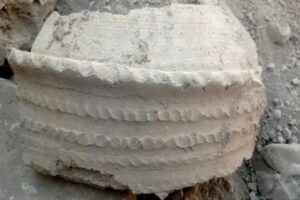
Abbaspour added that based on his examination of the pottery fragments left behind, some of the pieces resemble those previously seen in large storage jars used for food supplies, as well as other types of pottery dating back to the Sasanian era.
The cultural heritage activist emphasized that for many years, illegal excavators have targeted the 954-hectare city of Qandjan and its surrounding areas, including important sites such as the mausoleum of Imamzadeh Mohammad. The latest reported case of unauthorized digging in this ancient city occurred in Mordad of this year. Previously, multiple reports had documented repeated looting and damage to Qandjan and its neighboring sites, and efforts had been made to raise public awareness about these threats. In some instances, excavators even employed bulldozers to dig into the city’s buried remains.
He noted that the actions of these illegal diggers not only lead to the loss of valuable historical and national artifacts but also disturb and destroy archaeological layers, limiting opportunities for scientific study and potentially erasing crucial historical information forever.
Abbaspour highlighted that the recent intrusion into the mausoleum of Imamzadeh Mohammad is particularly concerning because it is located within the village cemetery of Sarmashhad, in an area that experiences regular foot traffic and is visible from certain village pathways. Additionally, the mausoleum sits less than 600 meters from the world’s largest Pahlavi inscription and one of the most significant Sasanian rock reliefs — the relief of Bahram II.
Abbaspour provided further details regarding the mausoleum of Imamzadeh Mohammad, explaining that studies on the two historical mausoleums in the Sarmashhad plain — Imamzadeh Mohammad and Imamzadeh Khong-Savar — suggest they likely date back to the 5th century AH and are connected to the Morshediyeh or Kazroniyeh dynasties. Consequently, both sites are of considerable historical significance. Additionally, a notable historical cemetery surrounds the Imamzadeh Mohammad mausoleum, some of whose tombstones have previously suffered damage or looting.
The cultural heritage activist emphasized that the extreme shortage of personnel for safeguarding the extensive area of Qandjan and its surrounding sites, coupled with the lack of access to modern monitoring equipment, has allowed this large Sasanian city and its environs to become a hotspot for illegal excavators, despite the ongoing efforts of heritage protection staff.
Warning about the ongoing threat, he stated that Qandjan and its surrounding areas urgently require the intervention of the Ministry of Cultural Heritage. Immediate deployment of sufficient protective personnel, along with comprehensive conservation programs and operational research plans for the site, is essential. Without these measures, the region’s historical treasures are at serious risk of continued plunder.
It is worth noting that the cemetery and historic mausoleum of Imamzadeh Mohammad in Sarmashhad village were registered as national heritage sites of Iran in 1388 SH (2009 CE) under registration number 27709. Sarmashhad village is located 50 kilometers southeast of Kazerun in Fars Province, within the eastern expanse of the ancient city of Qandjan.