

During a project to define the boundaries and propose protective zones for Tel Rubahi Kenareh, located less than two kilometers south of Persepolis, archaeologists discovered a jar burial dating to the Banesh period (early Elamite) along with a dense cultural layer linked to kiln activity.
According to ISNA and the Cultural Heritage and Tourism Research Institute, the project, carried out with the institute’s approval and in collaboration with the Persepolis World Heritage office, aims to precisely map the settlement and establish its protective perimeter.
Fazlollah Habibi, head of the Tel Rubahi Kenareh archaeological team, noted that the site is a significant cultural settlement in the Marvdasht plain, associated with the Banesh period, situated near Persepolis and northwest of the important Tel-e Bakun site.
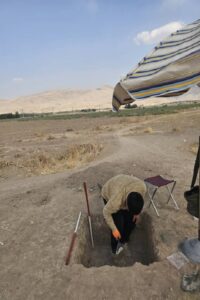
Key goals of the project include delineating the archaeological area, designing protective measures against environmental and human threats, documenting findings, and studying changes and damages to the site. The plan involves excavating key points, using modern technologies such as drone imaging and DGPS mapping, and analyzing surface artifacts in the laboratory.
Habibi stated that the project is funded by the Persepolis World Heritage Office, and its findings will be crucial for emergency preservation, protective planning, and understanding human settlement patterns in the Marvdasht plain during the 3rd millennium BCE.
He emphasized that the initiative represents an important step in documenting and safeguarding one of Iran’s valuable archaeological sites, while also laying the groundwork for future research.
To date, 13 test trenches, each one square meter in size, have been excavated at Tel Rubahi Kenareh, revealing significant discoveries, including a Banesh-period jar burial and a dense cultural layer associated with kiln activity.
Contrary to previous assumptions that the site was a 100-by-100-meter square, investigations indicate that Tel Rubahi is elongated along an east-west axis, measuring at least 200 meters long and 100 meters wide, underscoring the site’s greater importance and extent than previously estimated.