

Archaeologists have uncovered two separate graves of warriors buried with iron swords and daggers at the Velem Cemetery in Behshahr, Mazandaran Province. The tombs are thought to belong to the Sasanian period.
According to ISNA, Rahmat Abbasnejad Seresti, excavation director and faculty member at the University of Mazandaran, stated that the second phase of the rescue excavation and the boundary-mapping project at Velem Cemetery, near the Gelvard Dam in Neka, is underway. A 10-member team of experts in archaeology, anthropology, geophysics, GIS, remote sensing, and related sciences is conducting the work under the scientific supervision of the Mazandaran Department of Cultural Heritage, as part of a research contract between the Cultural Heritage Research Institute and the University of Mazandaran, with funding from the Mazandaran Regional Water Company.
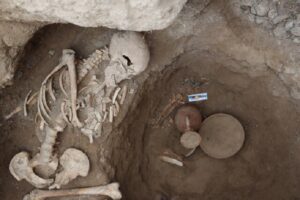
He noted that the first excavation season took place in the summer of 2021 and lasted three months, uncovering prehistoric artifacts from the Chalcolithic, Bronze, and Iron Ages, as well as tombs from the Late Iron Age (800–550 BCE), including Parthian-era burials.
The archeologist stated that the village of Velem, located in the Central District of Behshahr County within the Hezarjarib region in eastern Mazandaran Province, lies at an altitude of around 850 meters above sea level. Hezarjarib, the easternmost part of the northern slope of the Central Alborz range, is home to numerous mountain cultures and civilizations that remain hidden and in need of extensive and thorough research.
The University of Mazandaran faculty member explained that the tombs discovered during this season, like those from the previous excavation, are catacomb-style in structure. Most of the tombs feature an irregular rectangular corridor serving as an entryway, leading to a stone-lined section and the burial chamber. The interiors are circular, typically composed of a burial platform and a pit for offerings. The two tombs found in this phase belonged to warriors who were buried with iron swords and daggers. Remains of other weapons, such as arrows and parts of bows, were also uncovered. Burial items including pottery and seal rings with engraved designs support the likelihood that these tombs date back to the Sasanian period.
He noted that the excavation also uncovered beads made of agate, glass paste, and stone paste, along with decorative items crafted from bronze, iron, and silver—including pendants, earrings, rings, seal rings, and circular bone plaques with engravings.
Abbasnejad Seresti added that the number, condition, and preservation of the skeletal remains found in both the current and previous excavation seasons offer a strong basis for various physical anthropology studies. These include analyses such as ancient DNA, stable isotope testing, paleohistology, paleopathology, and comprehensive research on dental remains. In total, nearly 30 graves have been uncovered at the Velem site in Behshahr, about half of which are suitable for such scientific investigations.