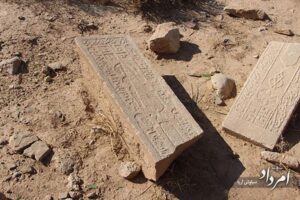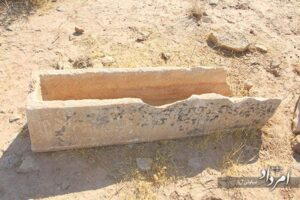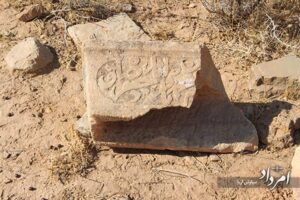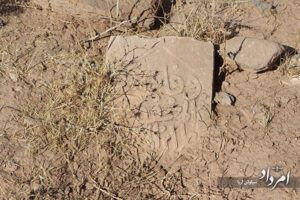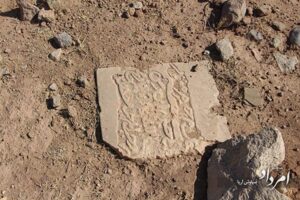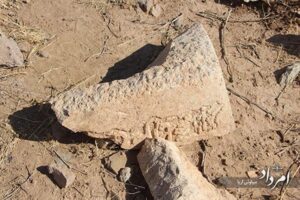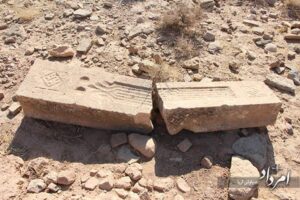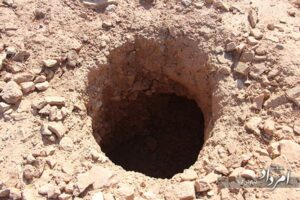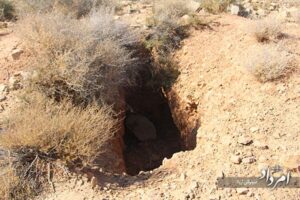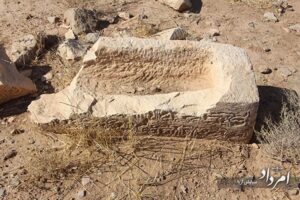


Treasure hunters and smugglers have ransacked the historic and invaluable Jamasb Cemetery in Fars Province, overturning centuries-old gravestones and destroying a site that had stood for hundreds of years.
Historic cemeteries are among the most treasured cultural and historical monuments, holding immense significance for historians and archaeologists. The gravestones, crafted by skilled artisans, feature intricate reliefs, decorative motifs, and striking inscriptions that together form a unique artistic and museum-worthy collection. From historical, archaeological, and social perspectives, these gravestones are invaluable.
Beyond their historical importance, these stones are also admired for their artistic and aesthetic value. Unfortunately, the care and protection of historic cemeteries across the country remain insufficient, leaving such sites exposed to neglect, vandalism, and looting.
Historic Jamasb Cemetery in Khafr Completely Destroyed
The historic and renowned Jamasb Cemetery, located in the village of Karadeh in Khafr County, has suffered a tragic and irreversible fate. This cemetery, once a testament to centuries of history, has now been almost entirely erased. Over the past several years, treasure hunters and cultural looters have systematically destroyed its gravestones, bringing an abrupt end to its centuries-old existence and leaving behind only sorrow and regret for failing to protect this ancestral heritage.
These unscrupulous individuals, driven by the illusion of hidden treasures, illegally dug into the cemetery, overturned gravestones, and shattered them, looting whatever they could. In doing so, they obliterated priceless cultural and historical artifacts for nothing but empty fantasies.
The tragedy is especially severe considering the cemetery’s significance: Jamasb was one of the largest, oldest, and most valuable historical cemeteries in the country. Its gravestones spanned eras from the Ilkhanid, Safavid, Afsharid, Zand, and Qajar periods. As recently as a decade ago, around 70 to 80 gravestones remained, documented through field visits and photography. By February 1402 SH, roughly 30 to 40 stones were still standing. Yet during a visit in early November 2025, the scene was devastating: nearly all historic gravestones had been destroyed or looted. Only one gravestone remained intact among roughly 15 partially surviving stones, while the rest had suffered severe damage.
This marks a sorrowful end to the centuries-long history of Jamasb Cemetery, a cultural and historical treasure lost to greed, neglect, and the failure to safeguard Iran’s heritage.
Cultural Heritage Laws and Protection
Iranian laws regarding historical and cultural heritage are explicit and strict. Article 558 of the 1375 SH Penal Code states that anyone who damages all or part of buildings, sites, complexes, or objects registered as national heritage—including decorations, annexes, facilities, inscriptions, or other culturally significant items—faces imprisonment from one to ten years, in addition to compensating for damages.
Despite these clear legal provisions, experts note that lenient judicial rulings often allow offenders to act with impunity, repeatedly targeting the nation’s historical sites.
In the case of Jamasb Cemetery, the author has informed the village council and the provincial Cultural Heritage Department, urging immediate investigation and protection measures. The only practical way to safeguard the remaining gravestones is to transfer them to the Haft-Tanan Stone Museum in Shiraz; otherwise, even the few surviving stones risk complete disappearance, following decades of looting and destruction.
Historical Significance of Jamasb Cemetery
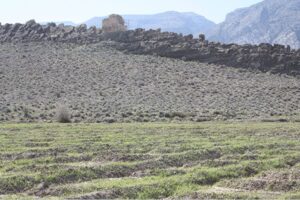
Jamasb Cemetery, whose origins trace back to the Sasanian era, is located on a mound in Karadeh village, Khafr County, 85 km southeast of Shiraz along the Shiraz–Jahrom road. After the Ilkhanid period, the site gradually became a full-fledged cemetery, with burials continuing through the Safavid, Afsharid, Zand, Qajar, and early Pahlavi periods.
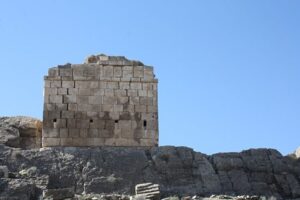
The cemetery is named after the nearby mausoleum of Jamasb, a distinguished Iranian scholar and son-in-law of Zoroaster, whose legacy spans more than 3,000 years. Recognizing its historical and cultural value, Jamasb Cemetery was registered as a national heritage site on 19 Mordad 1398 SH (August 10, 2019), under registration number 32585.
Situated amidst lush orchards and accessible via a narrow, unpaved path about seven kilometers from Khafr, the cemetery remains a vital historical and cultural landmark. Its centuries-old gravestones and artistic inscriptions make it an irreplaceable part of Iran’s heritage, emphasizing the urgent need for its protection against further damage and looting.