

After officials from the water authority and the trustees of the Nabadan Qanat in Abarkuh, Yazd, declared the historic qanat “dead,” the announcement sparked widespread public outcry. However, the Deputy of Cultural Heritage in Yazd emphasizes that water still flows in the qanat’s mother well, and plans are underway to restore its traditional course.
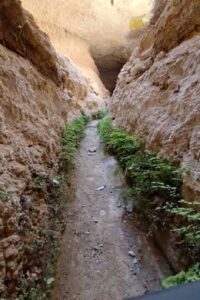
The Nabadan Qanat, dating back to pre-Islamic times and registered as a national heritage site in 2018, has recently become the center of a heated debate. Stretching over 11 kilometers, it passes four mills, an underground chamber, an icehouse, and numerous gardens. Most importantly, it serves as the primary water source for the Abarkuh Cypress, one of the oldest living trees in the world.
Less than a year ago, during a meeting with water authorities, qanat trustees, and local farmers, the “death” of the Nabadan Qanat was officially announced. Sources say that the qanat’s outlet dried up because, instead of clearing and restoring its traditional channels, farmers installed pumps at the mother well to extract water directly and pipe it to their fields. They argued that water losses due to evaporation and subsidence prevented sufficient flow to farmlands. While this approach dried the qanat’s surface outlet, water continues to flow underground at the mother well.
Experts like Mohammad Hossein Golestani-Pour, a cultural heritage activist in Abarkuh, and Zatollah Nikzad, a faculty member at the Cultural Heritage Research Institute, have criticized the declaration of the Nabadan Qanat’s “death” as a “major mistake.” They maintain that “the qanat is still alive, and with proper cleaning and restoration, its water flow can be fully restored.” Nikzad also warned that “removing the qanat from the irrigation system would mean losing Iran’s centuries-old water management traditions and could result in the destruction of a historic and cultural landmark.”
Responding to these concerns, Mohammad Reza Falahati, Deputy of Cultural Heritage in Yazd Province, told ISNA that “the Cultural Heritage Organization is committed to reviving the Nabadan Qanat.” He explained that while the qanat had been used for decades to irrigate the region’s ancient cypress tree, its “death” was announced in the 2010s. By that time, the water flowing in the qanat was largely from the well, as the qanat’s natural flow had significantly declined. To compensate, farmers had added irrigation water directly into the system.
Falahati added, “Until a few years ago, farmers diverted water from the qanat into pipes because the well water was being wasted and abundant. This matter is now being addressed legally, and we plan to hold meetings with the Agricultural Jihad Organization and the Regional Water Authority to take steps toward restoring the qanat.”
He emphasized that water still flows in the qanat’s mother well, stating: “Efforts must focus on the mother well, and the entire qanat system should be revitalized. We are following up to ensure these meetings take place, and funding will be provided by both the Agricultural Jihad Organization and the Cultural Heritage Organization to bring this qanat back to life.”
Falahati also addressed the legal aspects of the issue, noting: “At one point, well water was used in place of the qanat’s water, and later it was diverted from the qanat’s course. This matter is currently under legal review. Since the well water belongs to local farmers, it is unlikely the case will reach a final legal resolution, but we are still pursuing it. Our primary focus remains the restoration of the qanat itself, because whether the water comes from the well or through pipes, the qanat cannot truly be revived. The key is to work on the mother well so that the qanat can flow again naturally.”
He also outlined the steps needed to bring the qanat back to life: “It is essential to repair the mother well, rebuild the qanat’s pathway, and gradually restore its natural water flow.”
Falahati concluded by announcing that related meetings will be held soon, stating: “We are working to organize these meetings within the next month and will coordinate with the Abarkuh county administration and local governor’s office to ensure the restoration process is pursued more effectively.”