

The National Museum of Iran has reopened after a three-month closure with the launch of the exhibition “Narrators of Ancient Iran.” Alongside previously showcased masterpieces, the exhibition presents several rare artifacts brought out of storage for the first time, including a Neanderthal human tooth. The exhibition will run until 30 Aban 1404 (November 21, 2025).
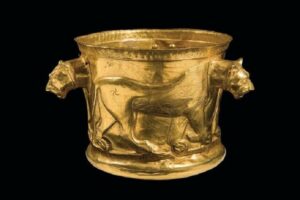
The museum’s reopening features 330 notable objects, many of which are being displayed publicly for the first time. Among the highlights are a stone relief of an Achaemenid soldier, an Elamite golden ring of power, golden cups from Hasanlu and Marlik, Safavid gold-embroidered textiles, and the Neanderthal tooth.
The National Museum had been closed during the recent 12-day conflict, with some artifacts transferred to storage. After more than three months, it reopened by order of the Deputy of Cultural Heritage, though the main galleries — Ancient Iran and the Islamic period — remain closed.
Fereydoun Biglari, archaeologist and Deputy of Cultural Affairs at the National Museum, told ISNA that the special exhibition offers visitors a rare opportunity to view a curated selection of exceptional and lesser-seen artifacts until the main galleries are fully reopened.
Fereydoun Biglari shared insights into the “Narrators of Ancient Iran” exhibition currently held at the National Museum of Iran. He noted that, as many know, a significant portion of the museum’s collection was moved to secure storage at the onset of the recent 12-day conflict. To provide visitors with an experience before the main galleries reopen, a carefully selected portion of the museum’s collection is now on display.
Biglari stated that the exhibition showcases over 330 artifacts, making it one of the largest in the museum’s history in terms of the number of objects presented.
The exhibition is organized across three galleries. The first gallery features prehistoric artifacts, including the oldest items from the Paleolithic period, as well as pieces from the Neolithic, Copper, Stone, and early metalworking eras. The second gallery presents artifacts from the early urbanization period, spanning roughly 3000 BCE to the Sassanian era. The third gallery focuses on the Islamic period, divided into two sections: objects from various Islamic eras and a selection of Safavid textiles.
Biglari emphasized that most of the displayed artifacts were uncovered during archaeological excavations from over 80 ancient sites. He also highlighted the exhibition of Neanderthal human remains, including a child’s tooth aged approximately 6 to 9 years, discovered in Wezmeh Cave in Kermanshah Province, dating between 40,000 and 70,000 years ago.
He emphasized that the Wezmeh tooth provides the first confirmed evidence of Neanderthal humans in Iran.
Biglari also drew attention to the oldest musical instrument discovered in Iran, now preserved at the National Museum and featured in the “Narrators of Ancient Iran” exhibition. The instrument is a flute made from a bird bone, dating back approximately 7,000 to 8,000 years. It was unearthed at Sang-e Chakhmaq, a Neolithic site near Shahrud in Semnan Province, known as one of the earliest settled communities of the Neolithic period in northeastern Iran.
He added that the exhibition showcases early metalworking in Iran. Archaeological evidence indicates that metalworking began in the 4th millennium BCE, making Iran one of the first regions to produce copper. The gallery displays artifacts related to copper processing from that era.
Biglari further highlighted several other significant pieces, noting that many are being exhibited for the first time from the museum’s storage. Among them is a rare fragment of a bull statue from Girshman’s excavations at Chogha Zanbil in Khuzestan. This fragment was found alongside a complete bull statue bearing an inscription, which is displayed at the Ancient Iran Museum as a guardian figure at one of the temple entrances.
He also drew attention to Elamite artifacts from the famous Arjan site, including the golden ring of power. Biglari noted that this piece had previously been exhibited in China and is now on display in the “Narrators of Ancient Iran” exhibition at the National Museum of Iran. Additionally, golden items from the Joubji site are also displayed in the exhibition.
According to the museum’s Deputy of Cultural Affairs, several Achaemenid-era artifacts are also on display, including architectural elements from the Palace of Susa in Khuzestan and a relief of an Achaemenid soldier from Persepolis. This relief, returned from the United States in 2019, was briefly exhibited at the National Museum and several provincial museums and is now available for public viewing.
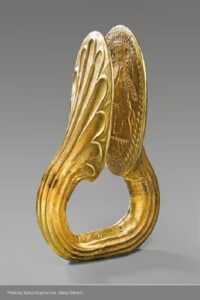
Among other notable Achaemenid pieces is a winged lion-shaped golden rhyton found in Hamadan, regarded as one of the museum’s most important artifacts. Biglari added that this item, along with other selected pieces, had previously been shown in the “Glory of Persian Civilization” exhibition in China before returning to the National Museum in early Farvardin (March 2025).
He also highlighted significant artifacts from the early urbanization period and later historical eras, including the naturally mummified “Salt Man” from the Chehrabad mine in Zanjan. This mummy, dating to the late Parthian and early Sassanian periods, was previously exhibited at the Ancient Iran Museum.
Biglari also highlighted several remarkable pieces in the exhibition, including a nail from Untash Napirisha, one of the Elamite kings, uncovered at Chogha Zanbil. He also drew attention to Iron Age treasures, particularly the golden cups from Hasanlu and Marlik.
He went on to discuss artifacts from the Parthian and Sassanian periods. From the Parthian era, the Lotus Flower wall painting, part of a mural from Kuh-e Khwaja in Sistan and Baluchestan, is on display and considered one of the museum’s lesser-seen treasures. Sassanian-period exhibits include decorative plasterwork and large busts of aristocrats from Hajjiabad in Fars, regarded as outstanding examples of Sassanian art.
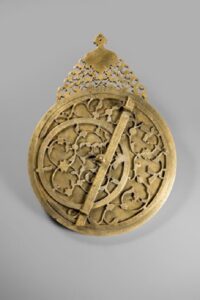
Regarding Islamic-era artifacts, the exhibition features manuscripts such as Masalik al-Mamalik, a Quranic manuscript from the Ilkhanid period (700 AH), Ilkhanid mihrab tiles, and a Seljuk-era astrolabe and celestial globe.
Another section of the Islamic gallery is devoted to exquisite textiles, including silk brocades adorned with floral and bird motifs, cypress tree patterns, and gold-threaded borders, primarily produced in Isfahan workshops during the Safavid era. Many of these textiles are being exhibited at the National Museum for the very first time.
The Deputy of Cultural Affairs at the National Museum of Iran noted that, in addition to the exhibition, photographs documenting the museum’s rescue operations during the recent 12-day conflict are on display. These images illustrate the evacuation and transfer of artifacts to secure storage, as well as the reinforcement of items that could not be moved, such as the statue of Darius.
Biglari also outlined the timeline for the museum’s full reopening. While the exhibition is ongoing, preparations are being made to reopen the museum completely. The plan is to gradually reopen some galleries of the Islamic Museum by Aban (November), followed by the ground floor of the Ancient Iran Museum, and finally the first floor.
He concluded by emphasizing that the museum’s staff used the closure period to reassess and enhance the display and arrangement of artifacts in the Ancient Iran Museum. He assured that all efforts are being made to ensure the National Museum of Iran reopens fully as soon as possible.