

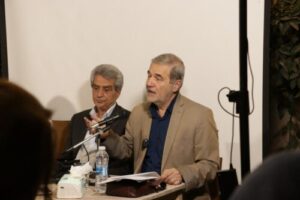
The “Iran and its myths” seminar was held at Didar gallery, organized by Charsoo Cultural and Artistic Institute and Shamseh Academy of Research, Education, and Studies, with support from the Scientific Association of Comparative Arts and Literature. Speakers included Dr. Zhaleh Amouzgar, professor of ancient Iranian culture and languages; Dr. Abolghasem Esmailpour, mythologist and Shahid Beheshti University professor; and Dr. Bahman Namvar-Motlagh, semiotician. The session was moderated by Mahdi Ansari, philosophy researcher and director of Shamseh Academy.
A 150-Year History of Mythology
Dr. Zhaleh Amouzegar began by expressing optimism:
“Attending gatherings like this reminds me that Iran will not die. The survival of Iran is reflected in this community of dedicated scholars.”
She criticized superficial interpretations of mythology in some countries:
“Trends often arise without solid foundations, leading to exaggerated symbols and misinterpretations. Some accept them unquestioningly, while others mock them, forgetting respect and nuance. This ignores the true purpose of myths.”
Amouzegar noted the scarcity of serious works on mythology:
“While many scholarly books are published abroad, few focus on mythology. We must first understand what a myth is. Mythology as a scientific discipline has only about 150 years of history, far younger than the broader history of religions.”

Dr. Zhaleh Amouzegar explained that in early societies, people relied on imagination rather than what we now call religious thought, philosophy, or historiography. Myths and historical accounts were born from this imagination, often inspiring awe. In Western traditions, what was inexplicable in the Bible or Torah was treated as legend or myth. Some scholars define myth more scientifically, viewing it as a product of the collective unconscious—personal dreams become individual myths, and shared dreams become national myths.
She added that mythology is a complex symbolic reality. Myths tell stories directly, offering a worldview and explaining the origins of phenomena, real or imagined. Elements of a myth gain meaning only in relation to each other, forming symbolic narratives that can inspire wonder, sometimes in tension with rational thought.
Mythmakers: the early historians and creators of literature
Amouzegar noted that myths are not literal history but can be seen as a form of natural history. Mythmakers were the first pioneers of history, art, and literature. For believers, myths carry meaning and, in some cultures, convey cyclical or eternal time—unlike historical narratives, mythic time is timeless.
Dr. Zhaleh Amouzegar explained that myths are sacred narratives with unclear origins, closely tied to culture. Their timeless characters often possess a halo of sanctity, and because myths are treated as real stories, they are sometimes linked to historical events. When interpreted carefully, myths follow an internal logic, and historical events can take the form of myths.
She noted that myths are adaptable, visual or symbolic, and that Joseph Campbell traced humanity’s mythic heritage from ancient peoples to modern creations, showing both diversity and striking similarities. Although modern societies have lost many connections to myths, they continue to guide human experience and give life meaning.
Amouzegar added that myths often arise from human vulnerability, fear of the unknown, and attempts to explain misfortune. Early communities imagined that gods and demons were responsible for natural disasters, embodying human emotions, desires, and imagination.
Dr Zhaleh Amouzegar distinguished between myths, legends and fairy tales. Myths are structured cosmological systems, while legends are fragmented and often draw from myths. Legends feature extraordinary events within everyday life, usually with moral lessons, whereas fairy tales always have happy endings for entertainment. Myths also differ from epics, where gods may take heroic roles.
She noted that ancient peoples unconsciously created myths, and repeating these myths gave them comfort, making them seem true. Myths evolve over time, blending across cultures and adapting to new contexts. Ancient Iranian myths were passed down orally for over a thousand years before being written. These narratives reflect eras that neither history can determine nor archeology. While myths do not correspond to specific times, patterns and parallels can sometimes be traced. Although often retold rather than studied scientifically, this tradition provides a foundation for future scholarship in mythology.
Dr. Zhaleh Amouzegar discussed the ongoing relevance of myths. Scholars see myths as significant in mysticism, cosmology, sociology, art, literature, and the study of civilization. While fewer new myths are created today, enduring myths continue to shape modern life, giving it meaning and depth. She stressed that understanding our past is essential to knowing who we are and where we are headed.
Amouzegar also highlighted the close connection between myths and ceremonies. Ceremonies are symbolic practices that engage with transcendent forces, often through repetition, and they enact and display myths. Whether myths arise from ceremonies or vice versa, their bond is undeniable. Real, lived ceremonies preserve the influence of myths and remain central to cultural life.
Aboulghasem Esmaeilpour, professor of ancient Iranian culture and languages at Shahid Beheshti University, highlighted the inseparable bond between Iran and its myths. He noted that key Iranian myths date back to pre-Aryan times, including the Elamite period over 5,000 years ago. In Khuzestan, the Elamites worshiped the god Inshushinak before Ahura Mazda, and artifacts like the 8,000-year-old Silak reliefs of Kashan reflect these ancient narratives. The Mithraic myth, predating both Ahura Mazda and Zoroaster, traces to the second millennium BCE.
Esmaeilpour emphasized that the core of Iranian mythology is the cosmic struggle between light and darkness, good and evil. This duality shapes Iranian culture, from the spiritual and material worlds to human creation myths. Ancient Iranians often saw reality in stark contrasts—good versus evil, angel versus demon—embodied in figures like Ahura Mazda and Angra Mainyu. Unlike neighboring mythologies, where deities may display both traits, Iranian myths clearly separate forces of good and evil, a defining feature that remains central to Iranian cultural identity.
Aboulghasem Esmaeilpour discussed Zoroastrian myths and the enduring theme of good versus evil. He noted that this duality appears not only in Indian and Iranian myths but also in Manichaean myths of the Sasanian era, where light and darkness are in constant conflict. In Zoroastrian myths, the world is largely dark, with fragments of light held captive, highlighting humanity’s struggle against evil.
He emphasized that Iranian myths are mission-driven, guiding moral behavior and cultural identity. This duality has influenced Iranians throughout history, from the late Sasanian Mazdakite period to Islamic sects. The Shahnameh illustrates this cosmic struggle, contrasting Iran (good/Spenta Mainyu) with Turan (evil/Angra Mainyu), while some Turanian figures act benevolently. Understanding these myths helps Iranians interpret their history, values, and behavior, showing the central role of good and evil in their mythological heritage.
Aboulghasem Esmaeilpour discussed the cosmic struggles in the Shahnameh, like Fereydun vs. Zahhak and Kay Khosrow vs. Afrasiab, showing how repeated mythic motifs evolved into epic narratives. He highlighted the duality of Minoo/Frahr versus matter, noting its influence on ancient Iranian thought and its impact on Greek philosophy. Plato’s Ideas/Forms and the later Greek dialectic reflect this Iranian understanding of good and evil.
He also examined Iranvij, the earliest Indo-Iranian myth, set in desert regions of Central Asia. Humans battled drought and desert demons, explaining the prominence of water deities—Anahita, Tishter, Apam Napat—symbolizing the vital human need for water. Esmaeilpour emphasized that myths blend aesthetic beauty with practical human needs, showing that their core purpose is survival and sustenance.
Esmaeilpour continued by discussing the Sun’s birth ceremony—Yalda Night. He clarified that Yalda is not a myth but a ceremony grounded in myth. Its significance lies not in the long night itself but in practical needs: the sun’s return ensures the warmth and growth essential for agriculture. Iranians celebrated the sun not for beauty but for sustenance, marking the solar cycles to secure crops and survival.
He explained that many ceremonies addressed human needs, while myths served both spiritual and material purposes. Iranian myths juxtapose an ideal world against an anti-ideal or “demonic” world. The mythic narrative insists that humans must struggle against chaos, and victory is inevitable. This conviction underlies the belief that the future belongs to the Iranians, and the long dark night ends in light.
Esmaeilpour also emphasized that beyond aesthetic value, myths remain vital as models for contemporary art and literature. Drawing on 5,000-year-old Iranian myths, artists and writers can create works as impactful as European classics rooted in Greek and Roman myths—or Latin American masterpieces inspired by their ancient myths. Myths endure, continuing to inspire art and literature today.
Esmaeilpour emphasized that the discussion is not about placing Iranian myths above others, but understanding their core themes. Unlike Greek myths, where gods often indulge in worldly pleasures, Iranian myths focus on the struggle between good and evil. Shahnameh is key for this understanding, presenting heroes and villains as models for personal and cultural reflection. By studying these myths, Iranians can recognize virtues to cultivate and flaws to overcome.
He noted that Islamic myths are fewer and underdeveloped, though similar dualities appear in Sufi and mystical traditions, where the material self-conflicts with the spirit. Even ancient Persian words reflect this cosmic struggle.
In conclusion, Esmaeilpour argued that Iranian myths live within every Iranian—they are not just in texts, images, or statues. Each person embodies the tension of good and evil, with ultimate triumph assured. As the epic heroes of Iran show, the Iranian myth declares: “Without Iran, may my body not exist.”
Bahman Namvar Motlagh, Iranian semiotician and professor at Shahid Beheshti University, emphasized that first comes the Iranian people, then the land they inhabit. He stated that Iran is the oldest country in the world, yet the question “Who is Iranian and what is Iran?” remains unresolved, as it arises anew in every era. He noted that many attempts to answer it fail because the question is not fully considered or is misunderstood.
On identity, he explained that some view it as fixed, others see it as entirely changeable, while thinkers like Paul Ricoeur argue that both the constant and the variable shape identity. To understand a nation’s identity, one must consider blood, land, history, language—and, importantly, myths. Myths act as mirrors reflecting the deepest traits, desires, and fears of a people.
Namvar Motlagh concluded that a nation that knows its myths truly knows itself. Not all cultures have the same mythological framework; some are more developed than others. Studying myths is, therefore, a way to understand the collective matrix that forms a society’s identity.
Namvar Motlagh continued by emphasizing that wisdom is a distinctive feature in Iranian mythological studies. Identity, he argued, arises from what sets a person or a group apart, not from what is common. In mythological analysis, the key question is what distinguishes one nation from another—what is elevated or lesser—as these distinctions define identity.
He highlighted the significance of the Persian root “دان” (dan, meaning knowledge or wisdom), which appears in words like daneshmand (scholar), daneshvar (wise person), and daneshgah (university), showing its central cultural importance. Quoting Ferdowsi: “In the name of God, the Creator of Soul and Wisdom” and “Better to have a wise enemy than a foolish friend,” he illustrated how Iranian thought consistently links ability and wisdom as essential virtues.
Namvar Motlagh added that in all mythologies, wisdom holds importance—for example, Enki in Mesopotamia, Prometheus in Greece, or Athena combining knowledge and war. However, Iranian mythology uniquely elevates wisdom above martial power. From the very beginning, the cosmic struggle is between Asura and Deva. While most Indo-European traditions favor warrior gods, Iranians chose Asura—later named Ahura Mazda—closely linked with wisdom. The first creator of this wisdom-God is itself wisdom: Vohu Manah (Beman), representing good thought and conduct, precedes other Amesha Spentas like Asha (order), because order cannot exist without wisdom. In this sense, Iranian mythology’s defining trait is the primacy of wisdom.
Namvar Motlagh categorized manifestations of wisdom into several types: divine wisdom (Ahura Mazda, Vohu Manah, Chista, Dena), sovereign wisdom (kings like Fereydun and Kay Khosrow), administrative wisdom (Viziers like Jamasp and Bozorgmehr), martial wisdom (heroes such as Zal, Rostam, and Giv), and practical wisdom (innovators like the first builders of qanats or windcatchers). He highlighted that constructing qanats required advanced knowledge, allowing communities to bring water from far distances—an achievement whose scale surpasses even the Great Wall of China.
Namvar Motlagh stated that the first Bīdxš (vizier) known to us is Shahrasp, mentioned in the Shahnameh but not in the Avesta, appearing in New Persian. He belongs to the era of Tahmuras, when bureaucratic institutions and writing were first established. During this period, the Diwan system and script entered Iranian culture, and Tahmuras is credited with overcoming the Diwan. While earlier figures like Siyamak were princes, Shahrasp was an ordinary yet wise person who attained the rank of Bīdxš.
He explained the key traits of a Bīdxš: purity and avoidance of wrongdoing. A royal advisor must be virtuous, righteous, guide the king, care for the court, and ultimately enhance the king’s farr-e īzadi (divine glory), a central concept in Iranian thought. Even the editing of the Shahnameh is attributed to a Bīdxš, as the vizier helps manifest divine glory for the king.
Namvar Motlagh continued: Ūšnēr is among the greatest Bīdxšān in Iranian mythic history, serving during the reign of Kay Kāvus, and unlike Shahrāsp, he is mentioned in the Avesta. The earliest known Andarz-nāmeh (book of advice) is attributed to him, reflecting his innate wisdom. In the Dēnkard (Book Seven), his guidance is recorded. He helped Kay Kāvus govern the seven countries, but as the Būndahishn recounts:
“During Kay Kāvus’ reign, rebellious Dēvān arose. Ūšnēr was struck down, misled Kāvus’ judgment, fell in the heavenly battlefield, and lost his farr.”
Motlagh explained that a wise Bīdxš beside a king is crucial; a poor advisor can deprive the ruler of divine glory (farr). The role and image of the Bīdxšān and Iranian wisdom are recognized not only in Iran but also internationally. Any ruler in Iran—even foreigners—had to rely on competent Iranian Bīdxšān. Iranian rulers who neglected them brought ruin, while foreign rulers, like the Mongols, who employed capable Bīdxšān such as Khwāja Naṣr al-Dīn Ṭūsī and Fażl al-Dīn Ḥamadānī, accomplished remarkable feats, including architectural masterpieces like Soltaniyeh. In many cases, the Bīdxš could be even more important than the king himself.
Namvar Motlagh noted that in European literature, figures like Zoroaster, Mani, and the Magi—symbols of Iranian wisdom—gained recognition as mythic icons of knowledge. Jean-Jacques Rousseau observed that among the philosophers of the East, Zoroaster was the first to be embraced by the West. Nietzsche also valued Zoroaster as the first thinker to articulate dualities, a notion echoed in Manichaeism. Similarly, Mithraism was the early Roman religion, and had Christian persecution not occurred, it might have remained dominant; remnants of Mithraic temples still appear. The Magi hold significance in Christian history for following Christ and predicting his birth, which helped cement their fame.
Motlagh added that a Magi is someone versed in hidden sciences and secret knowledge. This concept of wisdom aligns with Jung’s archetypes, particularly the magician, and has been expanded by scholars like Joseph Campbell. He concluded that wisdom and intellect are central to Iranian civilization, and the Bīdxshān exemplify this: whenever competent Bīdxshān guided the land, the people prospered and the country flourished.