Amordad reports that Dr. Abolhasan Atabaki, a historian with a PhD in History, announced the discovery of the world’s smallest ancient inscription, dating back 1,600 years, in Fars Province, Iran. The inscription, carved on the cliffs of the Marvdasht plain, dates to the late Sassanian period.
Dr. Atabaki described the artifact as a remarkable example of refined Iranian artistry from the Sassanian era. Measuring only 4 × 7 centimeters—roughly the size of a matchbox—it was inscribed using a tool just 0.5 millimeters (25 gauge) in diameter.
He added that such a discovery could become a powerful symbol of national heritage and a potential attraction for cultural tourism. However, Dr. Atabaki noted that structural and managerial shortcomings within the Ministry of Cultural Heritage, particularly in Fars Province, currently make this aspiration difficult to realize.
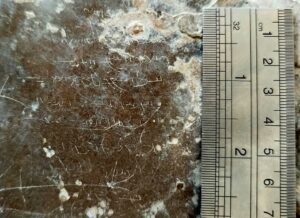
Najmeh Ebrahimi, another historical researcher, explained that the inscription consists of nine lines written in Book Pahlavi and Middle Persian, with the first two lines partially covered by rock deposits. She added that the inscription, created by a resident of the ancient city of Istakhr, contains a religious text addressing righteous deeds (krafah) and sins (winah), as well as the attributes of a high-ranking krafah in the Sassanian religious context. The text has been examined and studied by Dr. Atabaki and is expected to be published soon in academic journals.
Ebrahimi further noted that the evaluation of krafah (merit) and sin, rooted in the belief in the afterlife and the soul’s immortality, was a central concern throughout the Sassanian period and continued in subsequent religious inscriptions and texts. Accordingly, the works of Kartir, the high priest of the early Sassanian era, along with Zoroastrian texts such as Bundahishn, Vendidad, Arda Viraf Namak, The Darab Hormazdyar Narrative, Minavi Kherad, Dadestan-e Dinik, Shayest-Nashayest, Omid-e Asho Vahishta, Madian-e Hezar Dadestan, Sadr-e Nasr, Dinkard, and many others, all discuss this concept. The overarching idea conveyed is that the souls of the virtuous, who perform good deeds, are rewarded in heaven, while the souls of wrongdoers’ experience punishment (padafrah) in hell as a means of atonement.