

The trilateral agreement between Trump, Pashinyan, and Aliyev—seen as a continuation of the infamous Treaties of Gulistan (1813) and Turkmenchay (1828)—stems from multiple factors that directly threaten Iran’s territorial integrity, national security, strategic economic interests, and historical rights over 17 Caucasian cities.
- Baku’s Appropriation of the Name “Azerbaijan”
From its founding in 1918, the Republic of Baku, led by Mohammad Amin Rasulzadeh, adopted the name “Azerbaijan” stolen from Iran, aiming to occupy historic Iranian Azerbaijani lands, including Tabriz. Rasulzadeh himself acknowledged this appropriation.
In response, the Qajar government under Ahmad Shah protested strongly, sending a historic letter to Istanbul. The new republic was originally to be named the “Southeastern Caucasus Republic,” but the Ottomans insisted on “Azerbaijan,” a move that threatened Iran’s territorial integrity.
This shows that over a century ago, Ottoman ethnonationalists deliberately suggested the misleading name to Baku, laying the groundwork for the eventual division of Iranian Azerbaijan.
Since gaining independence in 1991, the Republic of Baku has openly promoted hostility toward Iran, earning a reputation as one of its most antagonistic neighbors. Baku’s textbooks distort history, falsely claiming that Persians and Russians divided an imaginary “Azerbaijani Empire” with Tabriz as its capital, and portraying successive generations in Baku as destined to attack Iran and occupy Tabriz.
These false narratives have persisted for decades, largely unchallenged by Iranian diplomats, and are now taught even more aggressively. In reality, the Treaty of Gulistan (1813) mentions “Iran” 33 times but never “Azerbaijan.” Historically, lands north of the Aras River were called Arran, Shirvan, or Caucasian Albania, while “Azerbaijan” referred only to regions south of the Aras, which remained part of Iran under the Gulistan and Turkmenchay treaties.
- The Mistake of Opposing the Reunification of Baku and Nakhchivan and Recognizing Baku’s Independence in 1991 Without a Name Change
Although the Qajar government had refused to accept the name “Azerbaijan” for Baku, after the Soviet collapse, Rafsanjani’s administration not only ignored widespread calls for the return of occupied Caucasian lands—including a direct request from Baku’s president—but also hastily recognized Baku’s independence without requiring a name change.
This reflected a prioritization of Shia and pan-Islamic interests over Iranian national ones, overlooking the strong pro-Iranian sentiment among Talysh, Nakhchivani, and Persian-speaking Tat communities across the Aras River. As a result, a key opportunity to reclaim Iranian lands affected by the Gulistan and Turkmenchay treaties—effectively nullified by the Soviet collapse—was lost.
- Neglect of Pan-Turkist Influence from Baku and Turkey in Iran
Since its independence, the Republic of Azerbaijan—famous for its “caviar diplomacy”—has spent hundreds of millions of dollars in Iran’s border provinces to lobby and recruit agents supporting its territorial ambitions. Evidence, including recent bribery scandals involving European officials, confirms this strategy.
Pan-Turkist networks embedded in Iranian society and some government institutions have been active for decades, referring to Azerbaijan and Tabriz as independent from Iran. They have even used bold propaganda, such as displaying banners during an Asian Champions League football match declaring, “Azerbaijan is not part of Iran.”
Baku and Turkey’s secessionist lobby, highly active during the Second Karabakh War, continues to downplay the threat of the so-called “Zangezur corridor.” Slogans like “Karabakh is Islamic land” have been used to justify support for Baku and fuel Pan-Turkist propaganda.
3- Baku and Turkey’s Lobby Influence in Iran
The Baku-Turkey lobby has long ignored Iran’s historical heritage in Atropatene and the legacy of Azerbaijani-Iranian patriots such as Babak Khorramdin, Shah Ismail Safavi, Sattar Khan, Baqer Khan, Baba Khan Ardabili, Martyr Mehdi Bakeri, and others. They have also censored the Supreme Leader’s statement that “#17 Caucasian cities are an inseparable part of Iran.”
Key examples of the lobby’s influence include:
- Blocking humanitarian aid to Armenia via the Norduz border during the 2020 war.
- Recognizing Azerbaijan’s territorial integrity during the 2020 Karabakh conflict without reciprocal guarantees.
- Obstructing Iran’s economic cooperation with Armenia, including Iran’s refinery project in Syunik.
Unchecked Pan-Turkist propaganda from Baku and Turkey has weakened Iran’s national security and strategic leverage. Had these efforts been countered, Syunik could have served as a buffer zone, strengthening Tehran’s influence over the 17 occupied Caucasian cities and advancing Iran’s national interests.
- Silence on Iran’s Heritage in the 17 Caucasian Cities
Iran’s historical sovereignty over the 17 occupied Caucasian cities is indisputable. Before modern claims by Baku, Karabakh and Zangezur were firmly part of Iran, and centuries of Iranian rule remain well-documented despite Pan-Turkist propaganda from Baku and Ankara.
Karabakh, centered on Shushi (distorted by Baku as Shusha), has been under Iranian political authority since the Safavid era. Pana Ali Khan Javanshir, appointed by the Safavid Shah, and his son Ibrahim Khalil Khan Javanshir governed the region under Iran. The Gohar Agha Mosque in Shushi, founded by Ibrahim Khalil Khan’s daughter, stands as a symbol of Iranian heritage.
Karabakh and Shushi remained under central Iranian rule until Russia annexed them under the Treaty of Gulistan in 1813.
Iranian Heritage in Shushi and Maghri (Syunik/ Zangezur)
The Shushi Jameh Mosque, a masterpiece of Iranian architecture in the Caucasus, was restored by Iranian architects under Armenian administration. After occupying Shushi in the 2020 Second Karabakh War, Baku defaced its Persian inscriptions, distorting its Iranian heritage and falsely presenting it as “Turkish civilization”—similar to the tampering of Nizami Ganjavi’s tomb in Ganja.
Maghri in Syunik (Zangezur), north of the Aras River, derives its name from “Mehr,” the ancient Iranian sun deity. Under Shah Tahmasp II of the Safavid dynasty, Maghri was governed by Davit Bek, a patriotic commander who defended the region against Ottoman incursions.
Maghri Fortress (Maghri Berd) commemorates the five-day resistance of 400 local soldiers led by Davit Bek in 1727. Reinforcements from Shah Tahmasp defeated the Ottomans, and Davit Bek was honored with the title “Prince of Princes” for his valor.
Maghri (Zangezur) and Karabakh have historically been Iranian-populated lands and part of Iran until they were annexed by Tsarist Russia following the disastrous Russo-Iranian wars and the Treaty of Gulistan (1813).
In the second chapter of the Treaty of Gulistan, Meghri (spelled “Maqri”) is explicitly listed as a ceded border region to Russia, with the northern boundary defined by the Aldaguz Mountains (today’s Aragats Mountains in Armenia, north of Yerevan). The treaty details the separation of Meghri and the Aldaguz Mountains from Iran and their cession to Russia.
From a historical and legal perspective, the collapse of the Soviet Union in 1991 nullified the treaties of Gulistan and Turkmenchay, creating a legitimate opportunity for the return of the 17 occupied Caucasian cities to Iran. Despite repeated calls for reunification—documented in 1919, 1989, and even proposed by then-President Heydar Aliyev of Baku—Rafsanjani’s government opposed reintegration of Baku, Talysh, and Nakhchivan. Nonetheless, this right remains reserved for the Iranian nation.
- Nation or Ethnicity—Which Comes First?
Decades of neglect in emphasizing national loyalty, combined with the promotion of ethnic agendas, lack of education on national identity, and little focus on territorial integrity and patriotism in textbooks and state media, have led some officials—governors, parliamentarians, and city council members—to see themselves as separate from Iran. From official platforms, they justify ethnic nationalism while disparaging Iran itself.
Why have these officials not been taught that, according to Shapur I’s inscription at the Zoroastrian Ka’ba, “Iranshahr” denotes Iran, and that insulting Iranshahr is equivalent to insulting the nation’s sacred name?
In the absence of accountability, such figures freely promote tribal and ethnic agendas, often bolstered by opportunistic neighbors like Baku and Turkey.
- Armenia: Iran’s Safest and Most Reliable Neighbor
Unlike Baku and Turkey, which exploit historical tragedies—such as the 1.5 million Armenians killed in eastern Turkey and 120,000 Armenians in Karabakh—to spread propaganda and hinder Iran’s ties with Armenia, Armenians have long been respected members of Iranian society alongside Azeris, Kurds, Lurs, Mazandaranis, and Baluchis.
Throughout history, Iran has considered Armenians loyal neighbors. Today, Iran’s border with Armenia is its shortest and safest, and Armenia has never claimed Iranian territory or promoted expansionist narratives in its schools.
Armenia offers Iran its most secure and dependable route to the 17 Caucasian cities, Georgia, and Europe, forming one of four major north–south corridors alongside the Central Asian rail network, the Caspian Sea route, and Baku.
- Addressing the Anti-Iranian Zangezur Threat
As early as 2020, during the Second Karabakh War, the author warned that Baku’s ambitions extended beyond Karabakh to occupy Syunik (misnamed Zangezur) and tighten Iran’s strategic encirclement. At the time, the warning went largely unheeded, and recognition of the threat has now come too late.
The November 9, 2020, ceasefire agreement between Azerbaijan, Armenia, and Russia only called for “open communication routes” without mentioning the so-called “Zangezur corridor.” Despite this, Baku, with Turkey’s backing, has spent five years pursuing its unlawful claim over Syunik.
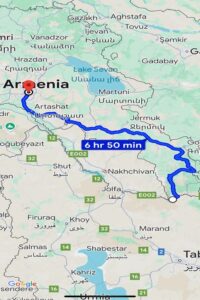
To counter this threat and secure Iran-Armenia connectivity, the author proposed the “Qarasu Passage,” which could shorten the difficult 400 km Norduz route from Iran to Yerevan into a 50 km road over Qarasu, reducing travel time from ten hours to one. Qarasu, a narrow 3 km stretch along the Aras River connecting Iran’s Poldasht-Maku area to Ararat in Armenia, has become the sole link between Turkey and Nakhchivan since the Soviet collapse.
Contrary to claims that Reza Shah gifted Qarasu to Turkey, historical records show that Qarasu and Iğdır were part of Iranian territories ceded to Russia under the 1828 Treaty of Turkmenchay and later transferred to Turkey by the 1921 Treaty of Kars, four years before Reza Shah’s reign. At that time, Nakhchivan had no direct border with Turkey; its border was with Soviet Russia.
Historically, Qarasu had been under Russian control since the reign of Fath-Ali Shah Qajar and the Treaty of Turkmenchay, and was never under Iran’s authority to be “given away.” Ninety-three years later, the Russians transferred it to Ottoman Turkey—not Reza Shah or Ahmad Shah. Historical international maps confirm that Qarasu and Iğdır were originally Iranian territories before being ceded to Turkey under the Treaty of Kars.
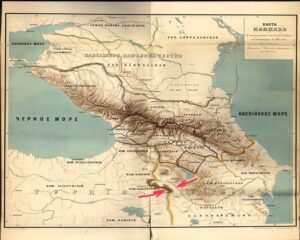
This raises a strategic question: why shouldn’t Iran, alongside the Norduz and Meghri borders with Armenia, have a second transit route through Qarasu? If Turkey and Baku insist on linking Baku to Nakhchivan via Syunik, Iran could similarly insist on a short, lowland, and easily navigable Maku–Qarasu–Yerevan Road.
Moreover, the Qarasu Passage could benefit both Iran and Armenia, as reopening the blocked routes in Syunik could be made conditional on constructing the Maku–Qarasu–Yerevan Road, thereby increasing Tehran and Yerevan’s leverage over Baku and Ankara in regional connectivity negotiations.
Advantages of Advocating for the Qarasu Passage:
- Linking Iran’s Panjarlu border region in Maku to Ararat, Armenia, as a secondary transit route should be a priority for Iran, facilitating regional connectivity in coordination with Armenia and Turkey.
- The under-construction Tabriz–Bazargan highway could connect to the Panjarlu border via the Qarasu Passage, then to Ararat and onward to Yerevan, reducing the current 400 km journey to just 50 km.
- Establishing a grade-separated road at Qarasu could also serve as a model for the 42-km width of Syunik (Zangezur) without disrupting the Norduz–Meghri–Yerevan route. This would allow Iran to maintain the existing 400 km route while simultaneously creating a shorter, faster secondary path under 50 km, cutting travel time to less than one hour.
- The Qarasu route to Ararat and Yerevan, unlike the mountainous Norduz–Meghri–Yerevan path, is flat and well-suited for heavy vehicles.
- By constructing elevated bridges or grade-separated crossings along Qarasu—from Panjarlu in Iran to Ararat in Armenia—Turkey would have no grounds to block the passage.
Consequently, alongside the Aras corridor, Iran can advocate for the Qarasu overpass or road through Syunik, countering Baku’s pretext for linking to Nakhchivan and preventing any threat to Armenia’s territorial integrity, the Iran–Armenia border, and Iran’s national security.
In essence, Iran recognized Baku’s independence without stipulating any corridor. Therefore, should Baku attempt to occupy Syunik or alter borders, Iran retains the right to revoke recognition and reclaim its 212-year-old historical claims over Nakhchivan, Talysh, and Baku.