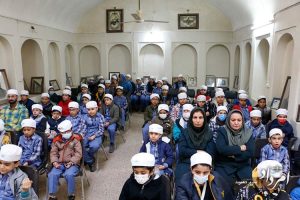


Shahab Farhadian, secretary of the 45th nationwide Zoroastrian Student Camp, discussed with Amordad how the country’s current situation has impacted the camp’s arrangements.
This annual camp, organized by the Zoroastrian Students Association to connect students from all over the country, was initially scheduled for August 16 to 24, 2025 (26 Amordad to 2 Shahrivar 1404), but due to recent developments, it was rescheduled to August 10 to 17 (19 to 26 Amordad). The camp began on August 10 at Markar Tehranpars with students who had pre-registered.
Farhadian, born in 1999 and a graduate student in general psychology, shared insights about the camp’s programs and challenges faced because of the changing circumstances.
What kind of impact did it have?
Because of conflicts with university exams, the camp was rescheduled to start a week earlier. Also, due to the 12-day war, the event was delayed by about 20 days overall. Furthermore, the second registration phase, initially planned to begin on June 22 (1 Tir), overlapped with registration for the Cup, causing some accepted students to withdraw from the camp due to these circumstances.
What is the basis for selecting students?
Students are selected randomly based primarily on their age. Each student has only one chance to participate in the camp. To confirm the randomness, you may notice some students’ names don’t appear on the accepted list in their first application year.
I encourage all Zoroastrian applicants to register again the following year if not selected, so they have an opportunity to attend.
How have you addressed this year’s water and electricity challenges?
Regarding the water shortage at Markar Tehranpars, unfortunately, we are experiencing water cuts. However, since the number of participants and staff is smaller this year, we hope the 2,000-liter water tank provided by the Markar Tehranpars executive committee will suffice. We are grateful for their support.
We are also making efforts to ensure proper management so that Zoroastrian guests attending the sedreh-pushi ceremony on August 15 (24 Amordad) between 4 and 6 pm will have enough water.
As for electricity, after consultations with the power company, we learned that outages are nationwide and unavoidable for Markar. Our strategy is to reduce electricity use as much as possible during these times.
What sets this year’s camp apart from last year’s?
This year, we incorporated feedback aimed at enhancing the camp experience by updating the rules while preserving its core values. Our goal was to reflect the culture of today’s youth, encouraging simplicity, reduced reliance on technology, and a sense of togetherness. We hope this camp will be as special and memorable for participants as in previous years.
Additionally, we took a risk by introducing camping elements to see how participants adapt and learn from it.
As always, we are committed to offering classes and workshops that inspire Zoroastrian teens, even if in small ways.
How many Fridays will the Sedreh-Pushi ceremony take place?
The exact number of days has not been finalized yet.
Who is covering the cost of the Sedreh-Pushi ceremony?
As in previous years, the Mobeds Association is sponsoring the expenses. We at the Zoroastrian Students’ Association are solely the organizers of the camp, and we strive to conduct the ceremony properly while also providing an opportunity for families to reunite with their children.
Will Mrs. Khadem, the camp’s mother figure, be present this year at the Sedreh-Pushi ceremony?
Mrs. Khadem has always supported us, and this year she continues to stand by the organizers and the association. Due to her special affection for us and the camp, she will be present during the ceremony, and we hope her presence will always bless the camp.
What is the total number of participants, and how are they distributed by city?
This year, 49 participants are attending the camp, broken down as follows: 21 from Yazd, 4 from Kerman, 2 from Zahedan, 2 from Karaj, 20 from Tehran
What arrangements have been made for participants’ bathing?
Yes, as in previous years, we have provided bathrooms for both the boys’ and girls’ dormitories. We also try to manage water use carefully to ensure that water shortages do not compromise personal hygiene during the camp.
Final remarks:
I would like to thank everyone who supported us in organizing this program. I am grateful that despite the unfortunate decline in the number of Zoroastrian youth attending the camp, the event is still being held. I hope the number of registered Zoroastrian students from across the country, participating in the camp organized by the Zoroastrian Students’ Association, will increase in the coming years.
In your opinion, what is the reason for the low participation this year?
I believe the main reason is the significant decline in the Zoroastrian population. The association’s youth team monitors the annual number of Zoroastrian students based on surveys and research, and the current figures differ greatly from when I was a student.
Additionally, societal conditions have led to fewer young people engaging with the Zoroastrian community and volunteer activities. I think more effort is needed to strengthen the community. I hope we can pave the way toward a more united and cohesive Zoroastrian society.