

For as long as I can remember, the white threads of the kushti have brought blessings to my home.
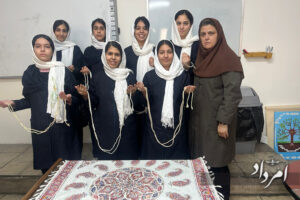
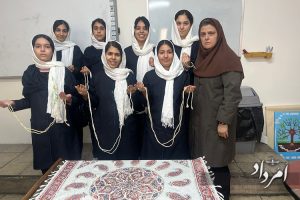
That sacred white belt always held a spiritual and pure meaning for me, though I had never seen how it was actually made — until that day. I watched as two skilled hands moved gracefully through seventy-two threads. I didn’t know the method, only that the number represented the seventy-two verses of the Gathas. As I stepped closer, I began counting: six strands, each made up of twelve threads — symbols of the six Gahambars and the twelve months of the Zoroastrian calendar.
I had never pictured the act of weaving a kushti, but now I was sitting face to face with Mahin Shahriari, a master weaver. For decades, she has woven this sacred belt — a symbol of awareness and wisdom that Zoroastrians tie around their waists three times during prayer, as a reminder of Good Thoughts, Good Words, and Good Deeds.
I had come to speak with a woman devoted to preserving the traditional crafts of Zoroastrian culture — someone whose thoughts, words, and actions remain consistently good, as required by the spiritual nature of this work. But I found myself wanting only to watch her weave. Even her words, like the threads in her hands, felt white, soft, and sincere.
Mrs. Shahriari, when did you begin weaving kushtis?
I started at the age of 12, and I’ve now been weaving for about 40 years.
Have you ever grown tired of it?
Not really — though illness has made it hard for me to continue now.
What inspired you to take it up?
Back then, we lived in Aliabad (Yazd), where nearly every woman and girl wove kushtis. I learned from my sister, Jahoon (Jahan).
Have you ever taught someone how to weave a kushti?
Yes, only once. Around 20 years ago, while I was in Yazd, a fellow Zoroastrian named Mahshid Dahmobed came to buy a kushti from me. When I told her the price was 1,000 tomans, she left, seemingly put off by the cost — but returned later. This time, she asked if I could teach her to weave one herself.
I explained that kushti weaving isn’t just a craft — it carries spiritual responsibilities. A weaver must be pure in thought and behavior, recite from the Avesta while weaving, and avoid gossip or idle talk. Mahshid accepted all of this, and after six months of dedicated learning, she completed her first kushti. Laughing, she said, “Mahin, now I understand why it costs 1,000 tomans!” It’s not easy work.
Was it a passion project, or a source of income?
I began purely out of interest, but over time, it also became a source of income for our family. And interestingly, in my experience, the money earned from kushti weaving has always brought blessings.
Do you weave on specific days?
No — I weave year-round, except on Vahman days.
She shared a vivid memory from decades ago:
“I had just learned to weave. It was Vahman day, and I was working in the workshop when my late father came in and asked me to join him in the fields. I replied, ‘Just 20 more centimeters and I’ll come.’ Upset, he warned, ‘Don’t weave on Vahman day.’ When I didn’t stop, he took a knife and cut the kushti in half. Since then, I’ve never woven on that day.”
Her father believed that since Zoroastrians abstain from meat on Vahman day, and the kushti is made from sheep’s wool, weaving it on that day would go against its spirit.
What makes the kushti special, and how is it structured?
The kushti is a narrow, sacred belt woven from 72 strands of sheep’s wool. These strands are grouped into six sections, each with twelve threads — symbolizing the 72 verses of the Gathas, the six Gahambars, and the twelve months of the year.
Sheep’s wool is chosen because the animal is gentle and beneficial — a symbol that, like the sheep, we too should live usefully and cause no harm. Each time the kushti is tied, it serves as a reminder of this commitment.
What do the four knots tied during the kushti prayer symbolize — both physically and spiritually?
The kushti is wrapped three times around the sedreh, symbolizing the Zoroastrian principles of good thoughts, good words, and good deeds. Four knots are then tied — two in the front and two in the back — representing the four natural elements: fire, air, earth, and water.
As each knot is tied, the weaver or worshipper reflects on core Zoroastrian beliefs: the oneness of God, the purity and truth of the Mazdayasna faith, the divine mission of Zartosht as the prophet of Ahura Mazda, and the importance of living righteously and helping others.
Do you also prepare the thread for the kushti yourself?
Yes, I do. The wool is brought from India, and I spin it into thread before weaving. Sadly, some people today use nylon thread, which isn’t appropriate for something so sacred.
How can one tell the difference between wool and nylon thread?
Wool thread has a softer, more muted appearance, while nylon tends to look shinier.
Who do you mostly weave kushtis for?
Primarily for sedreh pushi and initiation ceremonies — and always for those who I believe are truly deserving of wearing it.
What aspect of kushti weaving do you cherish most?
It brings me a sense of inner peace. That calm, spiritual feeling is what draws me to the craft more than anything else.
Have you ever woven a kushti for someone close to your heart?
Yes — for my daughters, my grandchildren, and all my dear ones. I’ve even gifted kushtis to people who couldn’t afford one, because I believe anyone who values its meaning should have the chance to wear it.
Do you sell kushtis to Zoroastrians living abroad?
Yes, I do. Many Zoroastrians outside Iran are interested in owning a kushti. I’ve sent them to places like India, Pakistan, the United States, and Canada.
How long does it take to weave one?
It really depends — there’s no fixed timeframe. It varies based on the weaver’s pace and how much time they dedicate to it.
Do you have an estimate of how many you’ve woven so far?
I couldn’t say for sure. I’ve been weaving for forty years. There were times when I made up to twenty a month, but now, due to health, I might only manage one or two.
Are young people still interested in learning this craft?
Not really. With today’s distractions like satellite TV, few show interests in traditional skills. Still, if any young person wanted to learn, I would happily teach them.
Given the difficulty of the work and your age, what motivates you to continue?
It’s my faith. My devotion to the Zoroastrian religion is what keeps me going.
How long do you plan to continue weaving?
As long as I’m alive — and able to do it.