

Once again, Iran’s heritage has been claimed by its neighbors while national authorities remain silent. The miniature art of Kamal al-Din Behzad—a masterpiece born in the heart of Iran—has been registered internationally under Afghanistan’s name, and Samanu, the ancient sweet of Iran’s Nowruz table, has been listed as a traditional food of Tajikistan. This is no longer mere oversight; it reflects chronic inaction, lack of cultural strategy, and the quiet surrender of Iran’s heritage.
These recent UNESCO decisions underscore how inattentive we have been in protecting our spiritual and cultural treasures. Every Iranian has the right to ask why Iran’s historical and cultural heritage is being registered under other countries’ names, and why officials have not taken action against this clear cultural appropriation.
Behzad Miniature—An Iranian Treasure—Registered to Afghanistan
It’s difficult to know whether to be frustrated by our own naivety or by the assurances of Iran’s cultural heritage officials, promises that ultimately proved ineffective. When news surfaced that Kamal al-Din Behzad’s miniature—a pinnacle of Iranian art—might be registered internationally under Afghanistan’s name, many were stunned. How could a masterpiece by one of Iran’s most celebrated artists be officially recognized solely as Afghan?
Alireza Izadi, Director General of the Office for Registration of Historical Monuments and Preservation of Intangible and Natural Heritage at the Ministry of Cultural Heritage, had confidently told reporters: “If Afghanistan wants to register a school of art as the ‘Behzad/Herat School,’ they must obtain Iran’s consent.” He referenced the rebab instrument case: “When we registered the rebab, UNESCO asked us to involve Afghanistan. After negotiations, Afghanistan agreed to joint registration.”
Izadi added that Iran had already registered the “Iranian painting” dossier with UNESCO, and any claim by Afghanistan would require justification of origin and geographical roots.
Yet, despite these assurances, the unexpected occurred: during the 20th session of UNESCO’s Intangible Cultural Heritage Committee (20 Azar 1404 / December 11, 2025), Behzad’s miniature was officially listed under Afghanistan.
This situation raises urgent questions for Iran’s cultural heritage authorities: what becomes of Iran’s rightful claim to Kamal al-Din Behzad’s legacy? Once again, Iranian cultural heritage has been claimed by a neighboring country, highlighting the consequences of inaction and misplaced trust.
In reality, this is not a matter of “Iran’s share.” Kamal al-Din Behzad’s miniature is entirely Iranian, and the reasons are clear. During Behzad’s lifetime, there was no country called Afghanistan. Herat remained part of Iran until just a couple of centuries ago, and its culture and heritage were fully Iranian. Behzad developed his artistry and innovations in Tabriz, under the guidance of Tabrizi masters, and his tomb is located in Tabriz—further evidence of his Iranian roots.
Given these facts, how could an Iranian-born artist, whose work reached its peak and immortality far from his birthplace, have his masterpiece internationally registered under Afghanistan instead of Iran?
It is still unclear how Iran’s cultural heritage authorities responded. Did they protest? Did they request Iran’s rightful recognition? If UNESCO’s justification is based solely on Behzad’s time in Herat, then by the same reasoning, figures like Rumi, Avicenna, or Biruni could be claimed by Turks or Arabs, and even Nowruz could be reassigned. This exposes a clear double standard in UNESCO’s approach.
Reports suggest that the dossier for Behzad’s miniature has been under consideration at UNESCO for six years. The question remains: what actions have Iran’s officials taken during this time? Some news outlets have described Afghanistan’s registration of Behzad’s miniature as “The Kabul Theft of Iranian Masters” (Rouydad 24)—a description that seems fitting, as there is little else to call it but the appropriation of Iran’s cultural heritage.
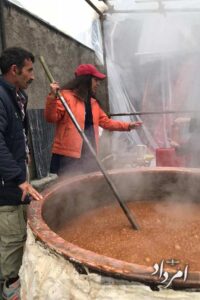
Samanu, Iran’s Traditional Delicacy—Registered to Tajikistan!
While we were still grappling with the shock of Behzad’s miniature being registered under Afghanistan, another UNESCO announcement added to our dismay: Samanu, the traditional sweet of Iran’s Nowruz Haft-Seen table, has been officially registered as a “traditional food of Tajikistan.” Every Iranian knows Samanu as an essential part of Nowruz, and nearly all have tasted this age-old treat. Yet now it is formally associated with another country—Persian-speaking, yes, but beyond Iran’s borders—without acknowledgment of its Iranian origins.
This latest registration underscores once again our passivity and lack of initiative in protecting Iran’s cultural heritage. Neighboring nations actively document, register, and promote their cultural elements to strengthen national identity, while we continue to neglect these responsibilities. The resources that Arab countries, Turkey, and Azerbaijan devote to claiming and institutionalizing heritage are vast—far beyond what we invest. Our inaction in this field is inexcusable.
As one source aptly noted: “Tajikistan’s registration of Samanu is not a threat; it is a mirror. A mirror showing that heritage fades without visibility, traditions are forgotten without cultural strategy, rituals are claimed by others without documentation, and a country that possesses rich heritage but does not present it hands over its narrative to competitors. If Iran wishes to preserve its cultural identity globally, it must act, not just rely on historical roots—it must actively recreate, showcase, and globalize its traditions. In today’s competitive cultural world, authenticity alone is not enough; active engagement is essential” (Payam Azerbaijan, 21 Azar 1404 / December 12, 2025).
Simply claiming that Iran is the birthplace of many traditions is insufficient. It must be demonstrated through action and documented proof, ensuring that the cultural heritage of Greater Iran is rightfully registered under Iran’s name on the global stage.