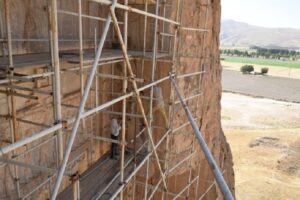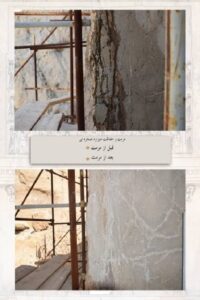


High on the cliffs of Naqsh-e Rustam, Xerxes’ tomb has stood on Mount Hajiabad for over two thousand years. Today, it is the focus of one of Iran’s most complex and delicate stone restoration projects. At 60 meters above ground, teams work to stabilize the monument, control natural erosion, and restore its visual integrity, making this the country’s largest cliffside conservation effort.
Led by Mostafa Rakhshandeh-Kho, the project brings together Iranian specialists in stone restoration, archaeology, geology, and architecture. The work is carried out under highly challenging conditions that demand specialized equipment, careful planning, and advanced technical skills.
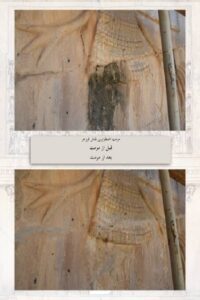
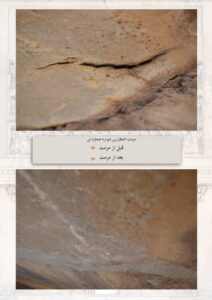
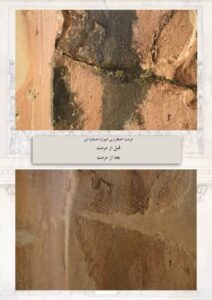
Rakhshandeh-Kho explained that Xerxes’ tomb has been thoroughly studied from historical, architectural, technical, and aesthetic perspectives. The most damaged sections have been meticulously cleaned, stabilized, and restored, preserving both the monument’s structural integrity and its historical beauty.
The project director reported that part of the restoration has been successfully completed, with noticeable improvements in both the protection and visual clarity of Xerxes’ tomb.
Rakhshandeh-Kho noted that these efforts are an important step in safeguarding Achaemenid heritage and ensuring this priceless monument endures for future generations. The manager of the Naqsh-e Rustam complex added that the work aligns with national policies on historic preservation, and continuing these efforts will be crucial for maintaining the authenticity and longevity of Achaemenid monuments.
This visual report showcases before-and-after views of the tomb, reflecting the dedication of Iranian specialists in one of the most complex stone conservation projects in the country.
Xerxes’ tomb is a rock-cut grave situated 26 meters above ground on Mount Hajiabad in the Naqsh-e Rustam complex, Fars province. The site also includes four other royal tombs belonging to Darius the Great, Xerxes, Artaxerxes I, and Darius II.