

At a recent scholarly gathering, Farzaneh Goshtasb described Katayoun Mazdapour as a woman who can truly be called the rescuer of Iranian Avestan manuscripts.
The event was the twelfth in the series Friendly Dialogues with Scholars of the Ancient World, held under the theme “From Noise to School,” and focused on the life, achievements, and era of Dr. Katayoun Mazdapour. Speaking alongside other panelists, Dr. Farzaneh Goshtasbi—an expert in ancient languages and cultures and a faculty member at the Institute for Humanities and Cultural Studies—remarked:
“Dr. Mazdapour’s service to Iranian culture is vast and enduring. Her legacy is a lifelong dedication, with a major part of it devoted to teaching, guiding students, and shaping future researchers.”
Goshtasb pointed to three main areas of Mazdapour’s work: studies on the Pahlavi language, research into the culture and dialect of Iranian Zoroastrians, and manuscript studies with a focus on the Avesta. She emphasized that Mazdapour’s contributions go even further, extending to fields such as the Shahnameh, Iranian mythology, and ancient law.
She went on to note that Mazdapour’s research in Pahlavi includes transcription, translation, and analysis of important texts such as Shayest ne Shayest (based on manuscript M. U. 29), the Ardavirafnamag, and several shorter and longer texts including Eogmad-echa, Sur-i Sukhun, and Daruy-i Khursandi. Mazdapour has also nearly completed work on several other challenging Pahlavi manuscripts, which remain unpublished.
Farzaneh Goshtasb noted that Dr. Mazdapour’s research on the Pahlavi language led to two significant works: Word and Its Meaning from Middle Persian to Persian and Easy Pahlavi, a textbook designed for beginners of the script and language.
She explained: “Access to the Zoroastrian tradition is impossible without Pahlavi texts, and progress in reading Pahlavi cannot be made without understanding that tradition. Dr. Mazdapour’s annotated works bridge this gap, making the Zoroastrian heritage more accessible to readers and scholars.”
Another major field of Mazdapour’s scholarship is the culture and dialect of Iranian Zoroastrians. Goshtasb emphasized that no other Iranian researcher has studied the customs and the Behdin dialect of Yazd so extensively. Her commentary on Shayest ne Shayest and her books Zoroastrians and Religions and Faiths in Ancient Iran are among her key contributions.
Goshtasb also cited a German article, later translated into Persian as “The Continuity of Ancient Rituals in Contemporary Practices of Zoroastrians in Iran.” She described it as one of the few European-published works on Zoroastrian rituals, notable for its breadth, conciseness, and detailed account of how these traditions have evolved in modern times.
Among Dr. Mazdapour’s most significant works is the five-volume Behdin Dialect of Yazd, which Goshtasb described as an achievement worthy of a scholar’s lifetime. Its distinct value lies in the examples provided for each entry, which together form a rich treasury of Zoroastrian customs, folklore, and beliefs. “I once read the first two volumes focusing only on the sections about rituals, traditions, proverbs, and expressions,” Goshtasb noted. “The material is rare and extraordinary.”
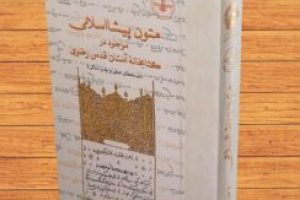
She also pointed to Mazdapour’s contributions to codicology and Avestan manuscripts. In 2008, Mazdapour published an article titled “Several Newly Discovered Avestan Manuscripts” in Ancient Iran, at a time when Professor Cantera and his student Toldo were reexamining the Vendidad and had concluded that Geldner’s edition of the Avesta required major revision.
During that period, Mazdapour also published several manuscripts, including a Khordeh Avesta copied by Molla Behrooz in 1226 Yazdgerdi (1273 AH/1856 CE) in Kerman, later released by the Research Institute of Cultural Heritage.
Another manuscript is the Yasna and Visparad, with no recorded scribe or date. These belonged to the library of Arbab Jamshid Soroush Soroushian and were published by the Institute for Humanities and Cultural Studies.
A third manuscript, one of the oldest known Avestan texts, is dated 976 Yazdgeirdi. It was copied by Fereydoun Marzban of Kerman in Sharafabad, Yazd, in memory of the young priest Jamshid Marzban Viraf, and includes the Vendidad along with the Yasna and Visparad.
Goshtasb noted that in 2006 (1385), Katayoun Mazdapour founded the Foundation for Ancient Manuscripts, with Mohammad Reza Mohammadi as CEO and Mazdapour as chair of the board. Several devoted Iranians and Zoroastrians joined the foundation, and the late Mobed Mehraban Firoozgari served as an honorary member.
Professor Cantera later read Mazdapour’s 2008 article “Several Newly Discovered Avestan Manuscripts”, marking a new phase in his research focused on locating and studying Iranian Avestan manuscripts.
Goshtasb emphasized that Mazdapour, with the help of colleagues, students, and fellow Zoroastrians, rescued dozens of Avestan manuscripts from near destruction. These were scanned and preserved in major libraries, including the Iranian Parliament Library, the University of Tehran Library, the Yeganegi Library, Astan Quds Razavi Library, and the Malek National Library and Museum.
Professor Cantera began digitizing these manuscripts many years ago, and in 2016, when he moved from Salamanca to Berlin, the project expanded into the CAB Project (Berlin Avestan Texts Collection).
Farzaneh Goshtasb emphasized that Dr. Mazdapour deserves to be recognized as the true savior of Iranian Avestan manuscripts. For her, it was enough to know that these ancient, valuable, and endangered texts were safely preserved.
One lesson Goshtasb learned from Katayoun Mazdapour—and keeps as a guiding principle—is that the work itself matters more than personal recognition.
In 2018, when Professor Cantera visited Iran, Dr. Mazdapour organized a commemorative event at the University of Tehran in his honor, and an issue of Frouhar journal was dedicated to celebrating his contributions.
Goshtasb added that in every talk or publication, Dr. Mazdapour acknowledged everyone who helped preserve the manuscripts, even in small ways. Though central to these efforts, she viewed her role as ensuring that her work honored the contributions of all who supported the project.
The session, featuring speeches by Farzaneh Gashtasb, Nadia Hajipour, and Hamidreza Dalvand, was moderated by Arzoo Rasouli (Taleghani) and held at 7:00 PM on Sunday, 16 Shahrivar 1404.