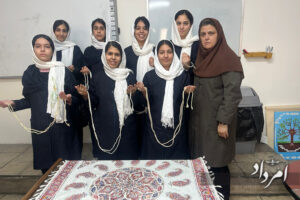


The people of Varzaneh call these weaving machines “karbafi”. It is an old and beautiful art which shows the talent and skill of the women who produce this.
Varzaneh is a district in Isfahan province. Because of the textile prowess of its inhabitants, Varzaneh is primarily associated with this industry. In the past, when Isfahan was brimming with water, the inhabitants of Varzaneh independently cultivated the cotton used for weaving and did not require cotton from other regions. However, due to the current water scarcity and drought, they are compelled to travel to other cities in order to procure the cotton necessary for weaving textile.
The canvas fabric is known as “kar” by the Varzaneh people. Thus, karbafi is identical to canvas weaving, with minor difference. Cotton and a weaving machine are needed to create fabrics used in daily life, like wrapper for bedclothes, shirts, wrapper for bathing items, towel, white tents, and other textiles. The truth is that weaving is no more as lucrative or in demand as it was once. Many individuals purchase the fabrics they require from the market, oblivious to the fact that there are weavers who toil ceaselessly and produce fabrics that are considerably more resilient and aesthetically pleasing than those sourced from abroad. Because of this, weaving is a manual industry that is gradually becoming obsolete.
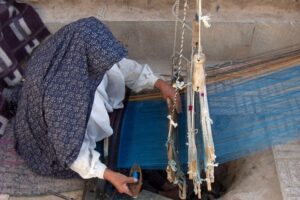
Weaving masters weave their textile in both plain and colored variety. Red, yellow, green and blue are the most used colors in weaving. But first the cotton fibers should be prepared, although sometimes woolen thread is also used in weaving. The cotton is spun into fiber and then the canvas is woven.
The weaving machines are simple frames made of wood and bamboo. This apparatus should be put in a shallow aperture. Then the weaver sits on his work bench, where he proceeds in a manner that demands perseverance and foresight. The weaving master employs a variety of instruments, including daftin (a device utilized for knotting), comb, board, mako, and various other small and large implements. Their character names include Milmil, Qandari, Anarubeh, Gol Shaftalo, Metqal, and Shamad, among others. There are many such designs.
Weaving is not exclusive to Varzaneh, and its like is found in other provinces, especially Yazd. The city of Meybod calls this craft “karchaleh” (meaning weaving in a shallow ditch). With it blankets and textiles are woven. “Shahrbafi” is also a similar craft for weaving wool and hair. In Ardakan, too, the weaving craft is quite common.
Unfortunately, modern textiles in the market have harmed the hand-weaving industry. Though “karbafi” is still used by some, who keep their ancient customs alive, and masters of this art are seen everywhere, its mechanism has not been the subject of adequate research, and few individuals have sought out karbafi masters to learn the intricacies of this craft. To register this art, which is at least 600 years old, a new perspective is need in order to avoid obsolescence.