

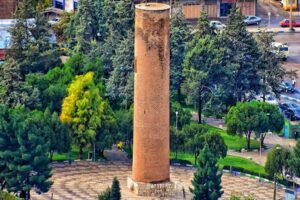
In the south of the current Khorramabad city (Old Shapoorkhasat), in Lorestan province, there is a tall and historical minaret close to the eyes of passers-by. There are many minarets throughout Iran, but what we see in Khorramabad has historical and ancient features that make it valuable and important. Its construction date is not precise, and some researchers think it is one of the ancient structures built during the Sassanid kingdom. Khorramabad minaret is one of the oldest minaret structures in Iran.
The brick minaret of Khorramabad city is now seen in the heart of a beautiful garden called Shaghayegh Park, located in a neighborhood called Ghaziabad. Every viewer will first want to ask which historic period does this minaret belong to. Archaeologists have found walls near the Khorramabad brick minaret, whose foundation goes back to the ancient times of Iran. They believe this wall was part of a fire temple, of which there is no sign now (except the wall itself). So, the brick minaret can also be related to a complex, a part of which was the fire temple. In the ancient times of Iran, many minarets were built on the road leading to Tisphon, the capital of Sassanid emperors. Those minarets were towers or watchtowers. However, many believe that the minaret of Khorramabad was built during the Daylamite period, in the fourth lunar century, or that the Daylamite kings rebuilt it. Of course, other hypotheses have also been suggested.
The architecture of the Khorramabad brick minaret
Long and cylindrical structures are called minarets. Minarets in ancient Iran, as we mentioned, were a tower for guarding and watching. On top of these towers and minarets, they used to light a fire so that they could inform or guide the travelers who were looking for the city. A point worth noting is that in Khorramabad dialect, minaret means place of light”. Perhaps in the distant past, the minaret had the same meaning. In the middle periods of Iran’s history, it was transformed into towers that were often built in the architecture of mosques. Minaret is an Arabic word, and its Farsi is “Goldasteh.” Goldasteh are the guiding towers, but their function changed in the post-ancient history of Iran and turned into part of the mosque. From the 5th century, changes occurred in the architecture of Iran’s minarets, and arrays were added to make them more impressive and beautiful. The use and types of minarets in Iran differ, and several categories exist. Still, they are all known to be very important and valuable.
Khorramabad brick minaret is a cylinder built on a square platform. In the Qajar period numerous structures were seen around. This we know from reference written in the middle of Shapurkhashat city in the past. This situation continued until the Qajar period, and numerous structures were seen around the minaret. We find this from references written in the travelogues of Europeans who went to Lorestan and Khorramabad city.
The entrance to the structure is in its western part. There are 99 steps to reach the top of the minaret. The minaret was built with stone and plaster, and its walls are sturdy. Its height reaches 30 meters, but it was higher in the past, and due to the passage of time, part of its top collapsed.
Between 1304 (1925) and 1348 (1969), the Khorramabad brick minaret was owned by the endowment organization. They did some work to revive the minaret. It was during the time of Pahlavi II that Khorramabad municipality built a park around the minaret and made it a spectacular place for people to walk and play.
The oldest minaret in Iran (after ancient times) is considered to be the Saveh minaret, which was built in 453 lunar years. Still, the point is that the date of construction (or reconstruction) of the Khorramabad minaret, as estimated by archaeologists, was in the fourth lunar century. The minaret of Khorramabad may be considered older than other such structures in Iran.