

The historical and natural 700-year-old grass of Zanjan Soltaniyeh is in danger of being destroyed due to the excessive extraction of underground water resources and the decrease in railfall, and is now looking towards the results of research by Zanjan University to bring it back to life.
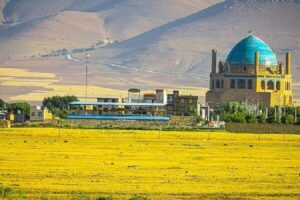
According to Mehr News Agency, the Soltaniyeh lawn has existed naturally in Soltaniyeh city for 700 years ago. It covers an area of more than 700 hectares and is considered a pleasant place for citizens to spend their free time. Since this area is of great value, it has been registered in the list of natural historical resources of Iran. This area is located 6 kilometers from the city of Soltaniyeh and gives a beautiful view of the Soltanyieh dome.
The reason for the natural growth of this lawn is that it is said that there is white soil in the 20-meter depth of this area, which prevents water from penetrating deep into the ground. Therefore, the lawn is irrigated naturally and continuously. In addition, near this natural grass, there are nearly 40 wells and aqueducts that irrigate it naturally.
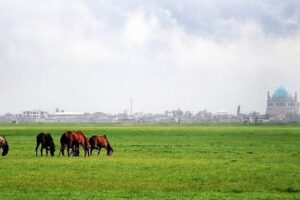
There is a fear of disruption of the ecosystem if the Soltaniyeih grass dries.
Mohammad Reza Yaftian, Director General of Environmental Protection of Zanjan Province, called the vitality of Soltaniyeh grass vital for the region’s ecosystem and said: “the drying of this grass will bring ecological risks, and the decrease in rainfall, climate change, and declining in soil moisture will turn this area into a center for dust storms.”
Yaftian added: “Soltaniyeh grass is a resting place for migratory birds that pass through this area in different seasons of the year, and if this nature is destroyed, we will no longer see these birds, and the ecological cycle will change, and it will harm an ecosystem.”
He further said: “In addition to this, there are rodents in this area that feed on Soltaniyeh grass plants, and if this area dries up, they will attack people’s fields and become a pest. Pest control itself causes another damage to the environment. That is, we will no longer see these birds, plus the ecological cycle will be effected, as a result harming the ecosystem.”
Yaftian pointed out that excess withdrawals from the water resources of Soltaniyieh’s natural grass area are damaging this area and added that unauthorized and excess use of water resources have caused the grass to lose its quality leading to widespread destruction of Soltaniyieh natural grass.
He said: “If the existing trend in excess use of water resources and changes in its use continues, there will not be any trace of the natural grass of Soltaniyeh in the next four or five years.”
Annual decrease of 70 cm of underground water level in the grassland of Soltaniyieh
The director general of Environment of Zanjan province pointed out that issues such as the impact on the migration of animals, wildlife, and agriculture in the region have been included in the letter of this General Department to the inspection organization, and said that the organization responsible for Soltaniyieh lawn is not the Environment Department, and according to article 2 of the law of conservation and exploitation of forests and pastures, it is the director general of natural resources where the national lands are concerned, and it is the director general of agricultural Jihad where agricultural lands are concerned. Transformation of land use is seen on Soltaniyieh natural grass. The most significant challenge in the Soltaniyieh lawn area is the unregulated and excess water usage. In some wells with turbines, more than standard is drawn, which must be checked and controlled.
Pointing out that the underground water level in Soltaniyeh natural grass area decreases by nearly 70 cm every year, he continued: “The aquifer of the Soltaniyeh area is funnel-shaped, and the center of this funnel is in the downward direction towards Kheyrabad and Soltaniyeh, where the water level is decreasing.”
Director General of Environment of Zanjan province reminded that the springs in this area are drying up, adding that there is the Shah Balaghi spring on the north of soltaniyieh natural grass, which, compared to previous years, its water flow has decreased.
Yaftian pointed out to the fact that there was not sufficient ecological research done about the construction of Bouin dam, north of Soltanieh grassland, and added: “An accurate and detailed analysis was not done before building the dam, and the Environment Department did not issue the necessary permit to build this dam; and there has been no inquiry in this respect from the environment Department either. There should have been an ecological assessment done in this respect.”
He continued: “The two issues of climate change and lack of rains and unauthorized harvesting and non-compliance with the water right are among the crucial reasons for the unpleasant condition of Soltaniyeh grass.”
The revival of Soltaniyeh grass depends on the results of the research.
Khalil Aghajanlu, Director General of Natural Resources and Watershed management of Zanjan province, also pointed out that the life of Soltaniyeh grass depends on water and said: “excessive withdrawal of water from the plains and the underground resources of the province has decreased the moisture of the surface, and on the other hand, due to decrease of rainfall, the running water which would feed this grassland has decreased significantly and there is not sufficient water left for the grass to grow.”
Khalil Aghajanlu stated that it is not possible to make a firm opinion about the causes of drying of Soltaniyeh grass and the ways to revive it and said: “This work depends on conducting very accurate research, and in this regard, Zanjan University is engaged in research on this issue, and after clarifying the costs it will be possible to get properly on.”
Pointing out that the vegetation of pastures is dependent on the presence of water resources, he added: “When we have sufficient rain, we will have better vegetation in this area, and the lower the rainfall than normal, the more it affects the growth of plants and causes drought.”
Aghajanlu commented about local authorities having ordered to build a fence to prevent cattle from entering the Soltaniyieh grassland, he said: “Considering that this area is close to Soltaniyeh city, it gets flooded every year, and I don’t think that livestock grazing has much effect on the grass drying.”
Forecast of an initial budget of 300 million toman for Soltaniyieh grassland research project
Director General of natural resources and watershed management of Zanjan province, pointed out that the drilling of unauthorized wells and excessive extraction of underground water has a significant impact on the plains, reminded that due to the decrease in rainfall, most of the seasonal and flood waterways have dried up and the water rights do not flow downwards. To revive the grass, we must control extraction of underground water resources.
Regarding the use of modern methods of surface irrigation with minor water consumption, he mentioned: “the implementation methods for revitalizing the grass depend on identifying the main factors affecting the drying of vegetation in this area and measuring the capabilities of the site, and according to these factors, we should provide the need water.”
Pointing out that there is no concern for the loss of plant species in this region, Aghajanlu reminded. This region has a seed bank of plants, and the main complexity is related to providing water and managing water resources. If the needed water is provided, the vegetation will revive itself.
Stating that 300 million Tomans have been earmarked for the Soltaniyeh grass research project, he said: “It is believed that the research phase will be completed by the end of spring next year. After that, the executive plan for grass restoration will be implemented.”